Typing With Wet Claws: The Kids Are All Right Edition

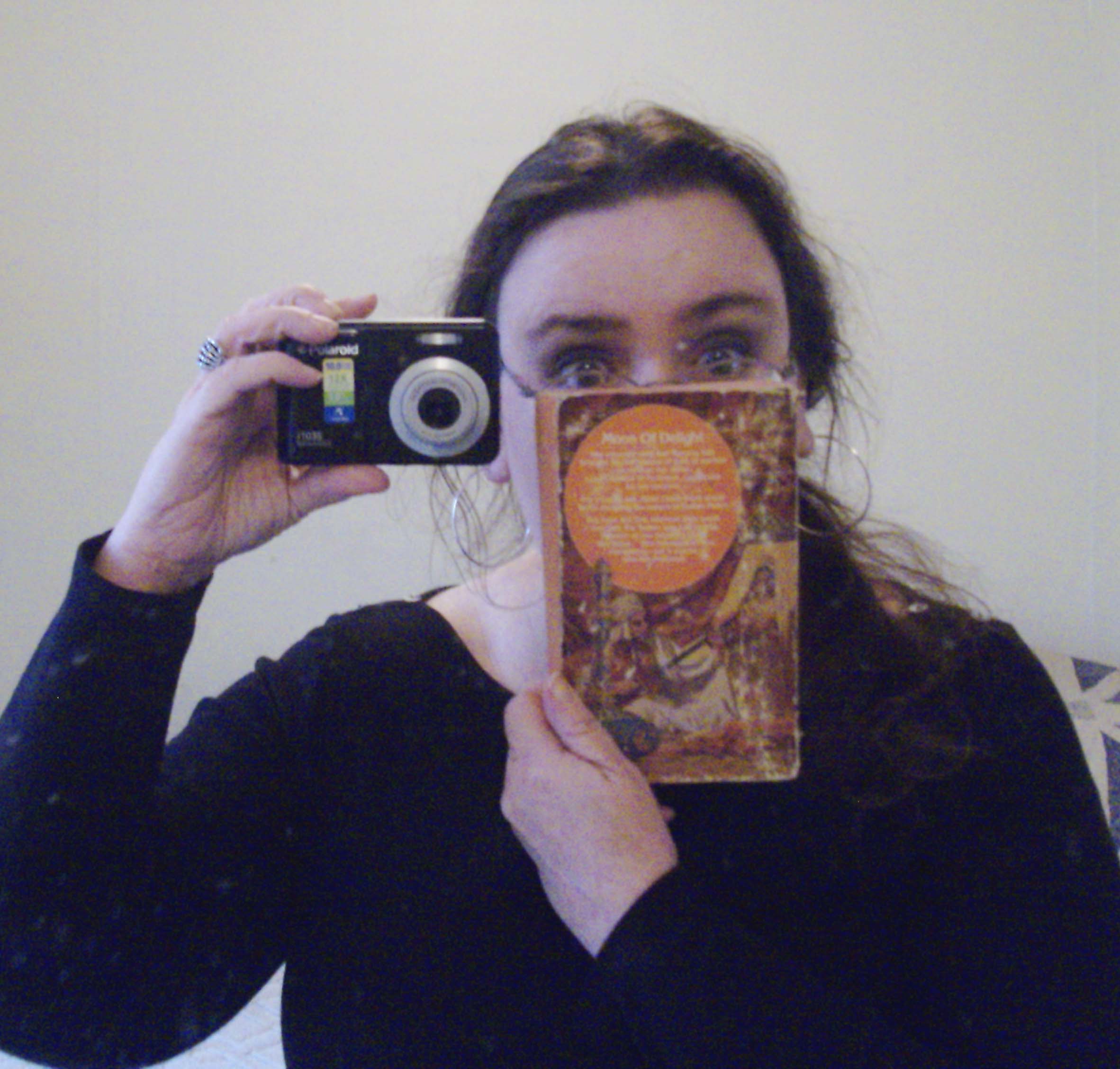
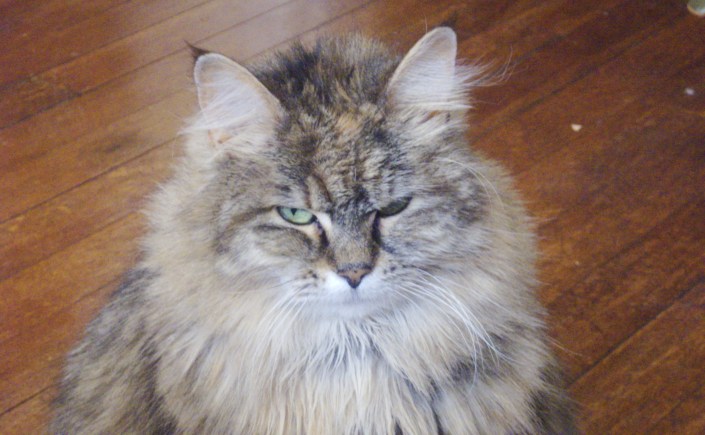
Hello, all. Skye here, for a special Thursday edition of Typing With Wet Claws. I am writing to you today from a sunbeam, where I am practicing my selfie game. Camera angle is everything, Anty says. I think she may be onto something.

Anyway, this has been a busy week for Anty. I will tell you more about that tomorrow, because then there will be more links. It is season finale time, so there are more people kissing on TV than usual, which means Anty gets to talk about all the TV kisses. She is also reading a lot, and working on both her novel and collaborating on a novella. Which means I may need to pitch in more with the blogs for a while. That is okay. I could use the practice.

Today, Anty is keeping her head down and eyes on her own paper. She has a post to write for Buried Under Romance, a novel timeline to create (she will tell you about that later) and there will be important kissy things on Big Bang Theory, so she will probably have to write about that later tonight. She is also reading her way through a big stack of books from the library. Here is the current read:

i1035 FW1.1

Reading now…

Anty has been reading a lot of young adult books lately, though her focus is still historical romance. She wasn’t sure at first why she was reading these books, this much and this fast, but they come in from the library and go out again, very quickly. She is still reading historical romance, as you can see from her currently reading list on Goodreads (are you Anty’s friend there? She likes to have friends there.) so it is not instead of her favorite genre, but along with it.

It took her a few books to catch on to what she’s reading for here. Anty loves a strong authorial voice (this means the way the human writes, not when a human reads a book aloud, although she does like to listen to books on audio, so sometimes, it is both) and there are some excellent ones in YA at the moment. Some of her favorites are: John Green, Rainbow Rowell, and Gayle Forman. Alongside the voice, the other thing she found that the books she likes have in common is the intense emotion involved when young humans first fall in love (with other humans, that is, not with kitties, although some of these books do have kitties in them.) These are both things she would like to see more of in historical romance as a whole.

Anty will do this from time to time, latch onto some seemingly random source of information and study the, um, word Anty says is not nice for kitties to type. We will say “stuffing” instead. She studies the stuffing out of it and then she has a new tool to put in her toolbox and tell her stories even better than before. Some of these sources come up after big life events, and Anty can trace this to last year, around this time. She took Fangirl, by Rainbow Rowell, out of the library and read it while in the waiting room of the people vet, and something clicked.

Authorial voice is difficult to explain for a human, so I, who am a kitty, am not even going to try. Basically, you will know it when you hear it. Or read it. If Elvis Presley, Luciano Pavarotti and Justin Beiber all sang the same song (not at the same time, please) it would not be neccessary to announce who was singing when. It is the same with writing. Each writer has a distinct way they tell their stories, a combination of everything they have ever heard, seen, read, done, etc. The really good ones cannot be imitated, but can inspire others to find what they recognize within that voice and let it fuel their own.

That is what Anty is looking for here. Strong voice, intense emotion and also how to use some Very Hard Things in life within an emotionally satisfactory love story. Not all of the love stories end happily in YA novels (but that is okay, because the humans are very young and have lots of time to find a mate that is right for them) but some of them do. Some even take more than one book to tell. Where She Went, for example, is the second installment of another book, If I StayThe first book was told from the female human’s point of view, and the second from the male’s, a few years later, after A Bad Thing Happened. This author has done the same thing before, in a different pair of books, and Anty finds this extremely interesting. Romance novels usually do have both points of view, but they are all in one book and take turns in different chapters. Having all of one point of view in one book and all of the other in another is new and interesting.

She is also listening to a lot of music by a band named Fun, which also gets into some intense emotions, so do not let their name make them sound fluffy. Right now, she is looking at me and tapping her foot, so I think that is all of my computer time for today. I will be back tomorrow with my regular post. In the meantime, you can see a list of some of the YA books she has liked here. If you know of any other books like this Anty might like, let her know in the comments.

See you Friday....

See you Friday….

Until then, I remain very truly yours,

Skye O’Malley Hart-Bowling
(the kitty, not the book)
Do What Works

Just write what you love. If you are passionate about your characters, your readers will feel that way too.
-Virginia Henley

This past week, I attended three different RWA chapter meetings. Tonight, I’m trying out a local writers’ group, and I submitted the first scene from Her Last First Kiss for critique. This group is not affiiliated with RWA, and is multigenre (slanted toward mainstream and literary, IIRC, but don’t quote me) so I have some reservations. I’ve had experiences both good and not so good with multigenre critique groups, but at the same time, want to keep an open mind and give things a fair shot.

The pluses are easy: this is a local group, meets at the local library (most of the time) which is a lovely walk from my house and I do like the members, from emails exchanged and the one meeting I was able to make a few months back. In-person critique and/or support groups can be like catnip for the extroverted writer. There really is some truth to the theory of hybrid vitality, and getting input from readers outside one’s genre of choice can provide insight that couldn’t come from anywhere else. Did I mention this group will be meeting in a library? Building full of books and movies gets an automatic point in its favor right there.

Then there’s the potential minuses. Not a romance group. In the past, this could have been a source of anxiety. Maybe I should try to tailor what I write to suit their needs. Writing is writing, right? Keep the peace, fit in, all of that stuff. Now…no. I write historical romance, I’m happy with it, I’m proud of it, and if it doesn’t fit with a particular group, then that’s probably not the group for me to bring my own work. I’ll critique pretty much anything, because I love stories, period, but knowing what to share with whom, that’s a learned skill.

There is always a chance, in a multigenre group, that somebody (count on at least one) has not read the genre a particular member writes. The good side of that? Honest reaction of a reader totally new to the genre. You get to be their first. Maybe they’ll find something new they might like, and so might you. Making assumptions about who reads what based on age or gender is usually a bad idea. When in doubt, ask. “So, what do you read?” is a classic reader/writer icebreaker, and a good way to test the waters. If it’s not a good fit, say so, in a polite and friendly manner, and move on along, no harm, no foul. Reach out to any individuals with whom you feel a connection and keep on doing you.

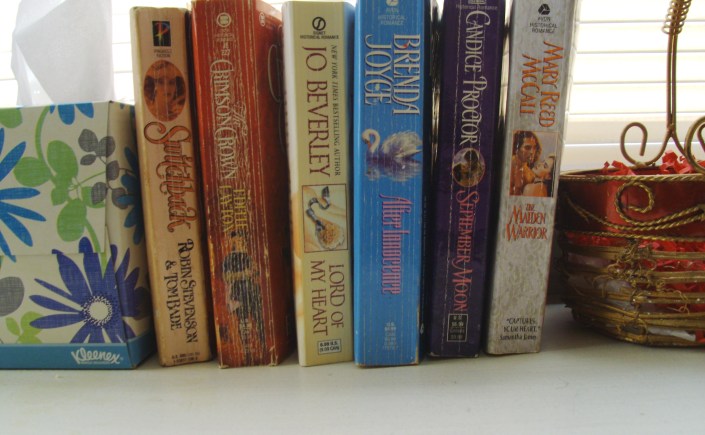
Which brings me to today’s picture. I have a lot of books. I mean, a lot of books. Most are in storage, but one box more than the boxes I’d tagged to make the move ended up getting on the truck, and into my office. Since I’m reorganizing said office in preparation for new-to-me desk, chair and computer (which will free my beloved secretary desk for longhand writing, which is what it was built for in the first place) I’m going through things that have sat for a while. I opened this box and hello, old friends. Where I’d been casting sidelong glances at a static TBR shelf of mostly new releases and telling them the reason they’ve been on that shelf for so long isn’t them, it’s me, the sight of these spines looking up at me from their cardboard cradle made my heart go pitty-pat.

Look at all those settings: 20th century time travel, Tudor England, Medieval England, Victorian England, Victorian-era Australia, Interregum England and Africa? (Not pictured because I’m currently reading it) Don’t see all of those that often these days, do we? All of these date from the mid 1980s at earliest to 2000 at latest, confirming that my current reading interests are, at present, very comfortably ensconced in books written/published in the 1990s, give or take a few years either way. After reading two brand-new releases (thumbs up on both of them) I’m ready for these. That’s what works now, and darned if I’m not plowing through the tale of a runaway bride in the midst of the English Civil War, and a hero who I’m pretty sure is going to wind up enslaved in Northern Africa, if I’m reading this right.

There is, of course, the voice of current marketing in my head, reminding me that we’re on page x and hero and heroine haven’t met yet, and that is not done. Grab the reader now, now, now, be fast, be clear, be…shush, voice. Mama’s reading. I’m engaged in the story; that’s enough. It’s a romance. They’ll be fine. That’s all I need to know, so that voice can be quiet now.

Typing With Wet Claws: Crunching the Numbers Edition

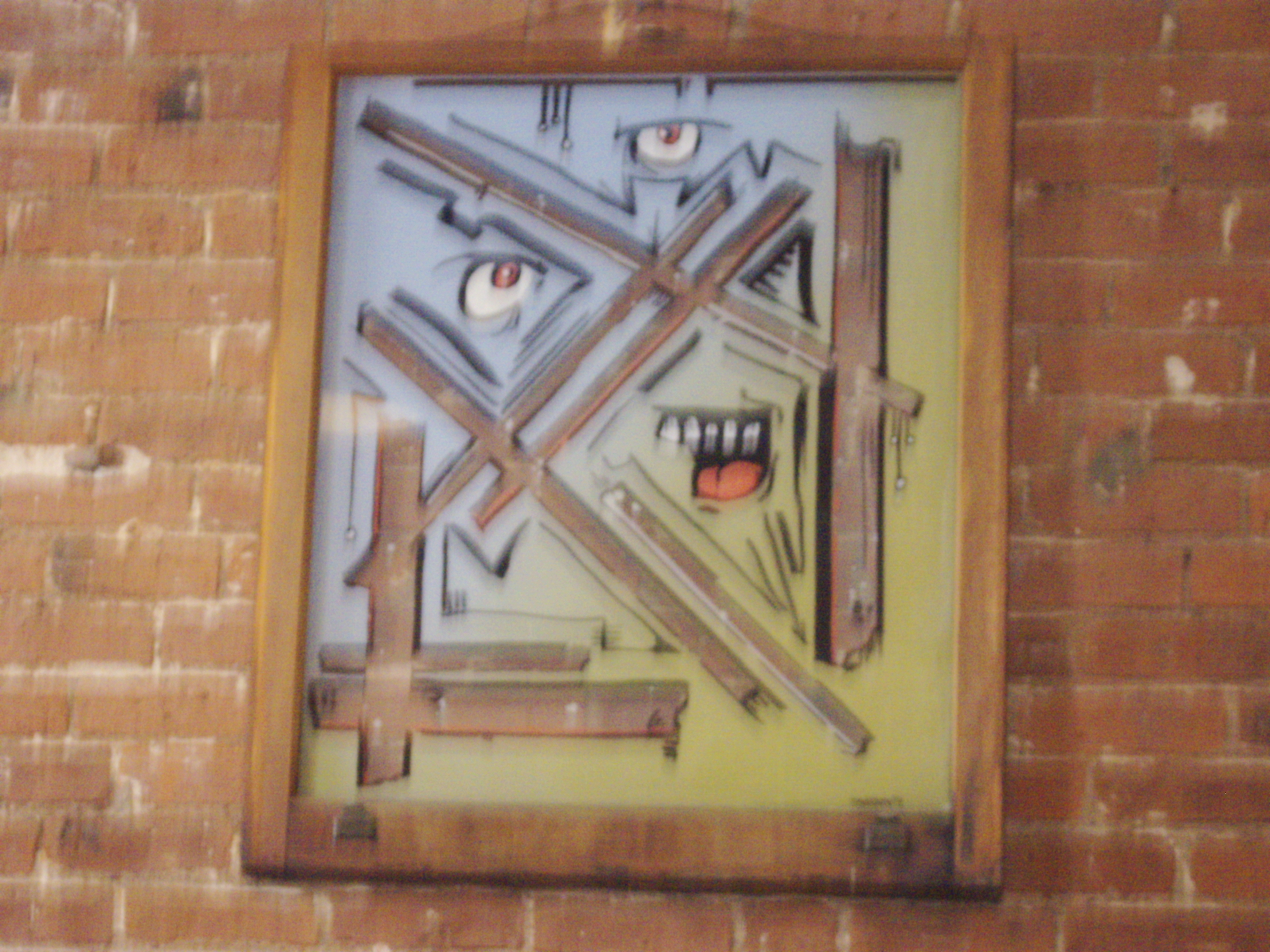
Hello, all. Skye here, for another Feline Friday. Exhausting week this time, with Uncle sick, but he is feeling much better now. It is still cold outside, even though there are some birds outside the living room window. If I could jump (I do not, because I have special paws) I would be on the window seat all the time, because birds are very, very interesting.  The art across from Anty’s favorite seat at the coffee house has changed. It is now this:

i1035 FW1.1

This week, Anty has been writing a lot. There are the blog posts, here and elsewhere, and she is hard at work on a new book. There is a lot that goes into writing a new book, besides only telling the story. Since Anty writes historical romance, she has to make sure that she has the historical details right, but not in a boring or heavy handed way. The love story is the center and the history has to come second to that, but still provide versimillitude. That is a big human word that means it has to feel right. Anty  has to get enough of the historical flavor to make sure the story fits its time and the people don’t think, talk or behave like modern humans, but still in a way that modern humans can understand and relate to them. Anty usually does have kitties in her books, and I am her consultant. I make sure the kitties are still kitties, because we do not change that much, no matter the time period.

Humans, though, are another story. I did not mean to put that pun in there, but i will let it stay. The humans who are in Anty’s stories…how should I put this?  They have problems. Personally, I think that if they  had more kitties, they would have fewer problems, but Anty says humans without problems are not that interesting. I guess she knows best, because she has books out and I do not, but I still think there should be more kitties. I hear there may be dogs in this book. I am not sure how I feel about that.

Yesterday, Anty spent a chunk of time figuring out how old the important humans in her story were. Sometims, Anty gets anxious about certain details. If she gets it wrong, does that mean the book is doomed? Is it too much detail or maybe to little? Is this marketable? Maybe she should write something more on trend (I have to remind her that is a very silly human concern, since trends in books are really about two years old when they hit the shelves, and that is slightly less than one third of my age. I say she should write the story and she says I am right and then she goes back to making clicky sounds on the keyboard and I can take another nap, because i find that sound soothing.)

Where was I? Oh, right, human ages. That involves numbers, and Anty does not like dealing with numbers. She would rather tell stories, but because her stories are historical, that means she is going to have to deal with numbers at some point. Anty likes to have clear boundaries when she writes. That means she needs to know how old her people are, what year it is, and things like that. Vague definitions make her fidgety, and I pick up on that, so really, if she wants a happy kitty, she needs to deal with this. Yesterday, she was on the glowy box, and her friend , Vicki, helped her figure out the ages.

Anty was having problems figuring out who was how old. Vicki is good at noticing when Anty goes into a loop (that means worrying about the same thing over and over again so that no writing gets done.) She suggested Anty look up the average age for first marriage of male heirs of peers during the era in which her story takes place. (Anty had already figured out the year the story has to take place by looking at historical events that impacted her people, so she knew when to look for this.) The answer was late twenties to about thirty. The hero in this book is a second son, so these figures did not apply to him, but it did apply to a secondary character, and Anty knows that the hero is two years older than that character, who is two or three years older than the heroine, so there was a lot of math involved, and talking about that is tiring me out, so I can only imagine what it was like for her.

Anty and Vicki agreed that it all depended on how old Anty wanted the heroine to be (Anty would say it’s not how old she wanted the heroine to be, but how old she is, because that’s the way people show up in her head, and you can’t go around telling people how old they have to be, because that’s not the way that it works. Plus, I think that would be rude.) and they could figure out everybody else’s ages from there. First round of numbers Vicki came up with, Anty shot down because everybody felt too old. So, Vicki asked Anty (Vicki has known Anty and the way Anty writes for a long time, so she is smart about things like this) how old the hero feels. Anty said twenty-seven, which is what Vicki also thought, so that meant the other human male was twenty-five and the heroine twenty-two or twenty-three. This is, some might be surprised to find out, not out of the ordinary for a woman to be that age at that time and not yet married. These are things humans find out when they do research.

Anty is giving me that look again, and I want a snack, so I will wind this up for now. If you did not get to read Anty’s post last week at Buried Under Romance, about how to pay tribute to a favorite author who has gone to Rainbow Bridge, it is here. If you are new to the blog and have not read her posts on remembering BertriceHuman, they are here, here, and here.

That is about it for this week. Until next week, I remain very truly yours,

Skye O’Malley Hart-Bowling
(the kitty, not the book)
Until next week...

Until next week…

Typing With Wet Claws: The Book, Not the Kitty Edition.

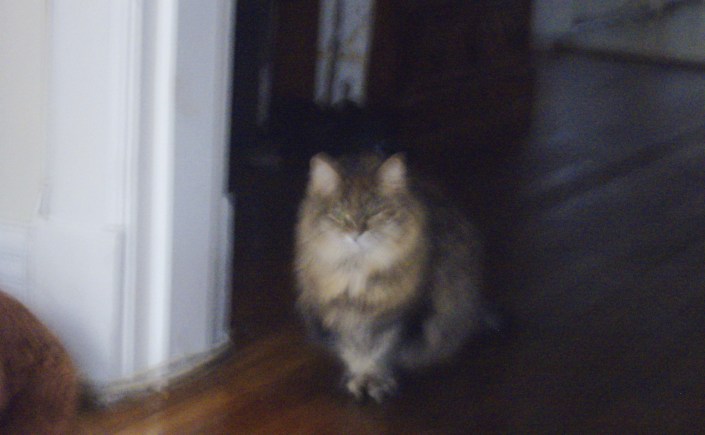
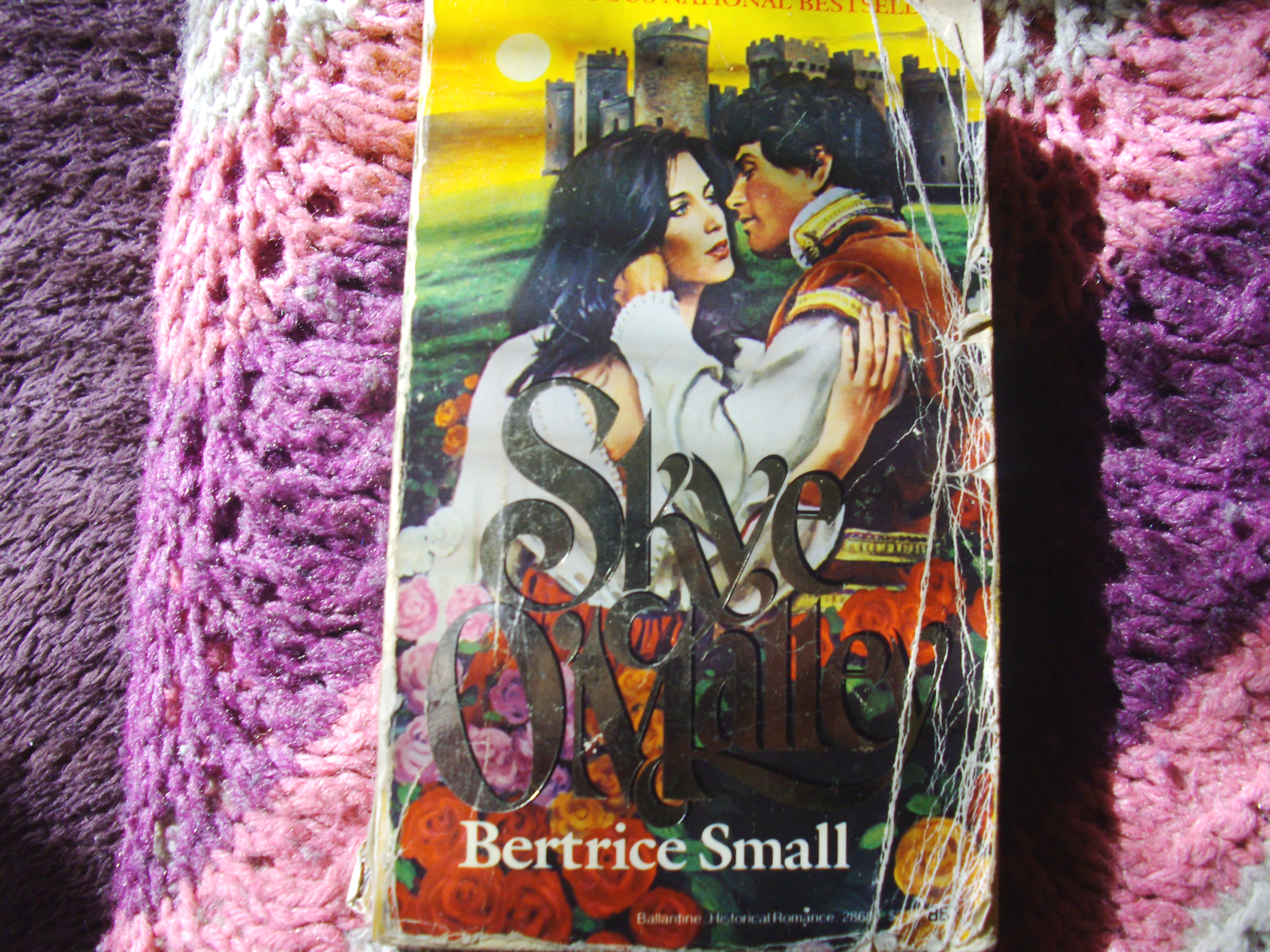
Hello, all. Skye here for another Feline Friday. I know my picture this week is fuzzy, but so am I. This has been a sad week, because Anty had somebody she loved go to Rainbow Bridge. That would be a human, not a kitty, the human who wrote the book for which I am named. My Anty first read that book a long, long time before I was born, but she and my Mama, who also likes that book very much, both agreed that its title fit as a name for the new family addition. The Skye O’Malley in the book was a brave, smart, beautiful female who had many adventures and triumphed over much adversity, to find true love at last. I like to think that fits, but there are some differences, too.

the book, not the kitty

the book, not the kitty

HumanSkye -I will call her that to avoid confusion, and I will still be me- lived a long, long time ago, in a place called Ireland and a lot of other places, like England and Algiers. I do not know where any of those places are. I am seven and was born in Massachusetts. I live in New York now. HumanSkye was both friends and not friends with a very powerful human named Elizabeth Tudor, who Anty tells me actually lived in the really real world. I know there is a difference between really real world people and those who live in writers’ heads like Anty’s characters do. HumanSkye was born in Bertrice Human’s head, but she was inspired by a really real world person named Grace O’Malley.

Writers, I have found, do that quite a lot. They will take something from the really real world and then make it into something else. Sometimes this is a person, like with HumanSkye, and sometimes, it is a place or part of a song or a picture. The writer takes many different things and mixes them together until they become one new thing. This is how books get made. My Anty is working on a book right now, and that  means that she is gathering lots of inspiration.

One thing she likes to do is make soundtracks for her stories. That means that she finds a lot of songs she likes, that sound like her characters or what happens to them, and she puts them in order and listens while she writes. Some writers do not like to listen to any music, or any music that has words, but Anty says the words do not bother her, and the lyrics mean something, so they are fine. I like when she plays very soft music. That makes me want to curl into a ball at her feet and take a nap. it is very relaxing when she does that.

Another thing she does is to make Pinterest boards with pictures of people and things that look like her story. I would share those with you, but she says that if she makes the board public, then she does not want to work on the story anymore, so they must stay private until the stories are done. She can put music with pictures on those boards, too, although I do not know how that works. Sometimes, she will stare at pictures and listen to the same song over and over and then she will write a lot. That is part of the writing process, too.

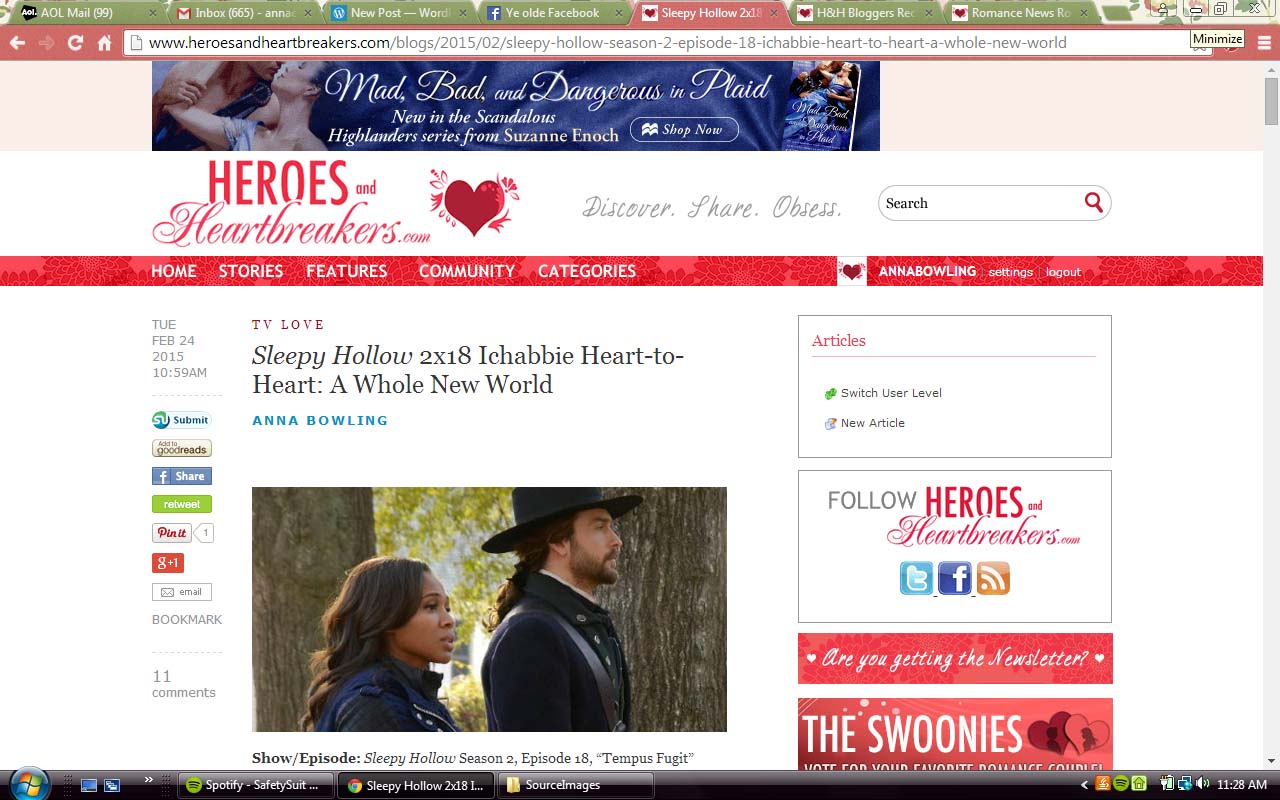
So is watching TV shows that she really, really likes. One of those is Sleepy Hollow. She says she now has an idea for a new colonial book, but it must wait until her current book is finished. She wrote about the season finale, which may or may not also be the series finale, here. It looks like this:

season finale or series finale, what do you think?

season finale or series finale, what do you think?

Anty had two other bits on Heroes and Heartbreakers this week. First, she shared her favorite read of February along with other H&H bloggers here. There are a lot of books in that post. I do not know how many of them contain any cats, though. They should put things like that on the website. More cats would read them then, I think, but nobody asked me.  There are also links to posts Anty wrote before about BertriceHuman’s books in the news roundup here. She will put links up later in another post with all posts where she mentions BertriceHuman, so they are easy to find. Maybe her best read for March will be one of BertriceHuman’s books. Or maybe the new Nick Hornby. She likes his books very much, too. She likes a lot  of books, which is probably a good thing for a writer.

One more thing before I sign off. Any has talked to SueAnn Porter and said that Bailey may be coming here for a posting playdate soon. I think that is very exciting, and also a little bit scary. If you know of any questions you would like to ask a writer’s pet, please let me or Anty know, and maybe we will use it.

Okay one more one more thing. Anty was quoted -twice-  on Peter Andrews’s blog, How to Write Fast, here. Anty first met Mr. Andrews a couple of years ago at the NECRWA conference, and they had a very interesting conversation about writing and reading. She took his workshop on how to write fast and still uses some of what she learned there in her writing now.

Anty needs the computer back, so that is all for this week. Until next time, I remain very truly yours,

Skye O’Malley Hart-Bowling,
(the kitty, not the book)

Until next week...

Until next week…

Remembering Bertrice Small, Part Two: As a Writer

Bertrice Small was the first professional writer I met in person, and long before I knew that writing stories of loves long ago even could be a job, but as soon as I figured it out, I knew that was what I wanted. I never had anything but support from this lovely lady, even when that support took the form of tough love.

The summer I was sixteen, I had the great good fortune to assist Bertrice Small’s assistant, which mostly consisted of answering fan mail, an experience I still cherish to this day.  This up close and personal view of what a working author actually does, besides the making up stories part only cemented my desire to pursue writing. I spent part of every weekday at the desk in the basement, so much that Bertrice joked that I was going to turn into a mushroom, spending all my time in the dark, underground. As I’m sun-sensitive, that was not a hardship, and I found the whole process fascinating. My “job” consisted of typing out responses to every piece of fan mail, already pre-sorted into one of three prepared responses. No email in those days, and so I had to physically type each reply from a template.  There were three of those: one for readers who read the latest book and liked it; one for readers who had read the book and did not like it (very few of those) ; and those who had read their first Bertrice book. There were special flags for letters that required a personal response beyond that, and those had to go back upstairs before I could stuff the envelopes and send them on their way.

I became a fan of her fan mail that summer. The stories in those letters proved beyond the shadow of a doubt the profound connection romance authors and their readers share. I still remember the letter from one reader who wanted to name her daughter Skye, but her husband vetoed the choice and they settled for another heroine-worthy name. Years later, I worked at a nursery school at college where two of the preschool students, sisters, were named Silver and Skye. Skye would have been old enough to have been born after that letter, so I always wondered if perhaps their mom was that reader. I never found out, but it’s possible.

That summer, I also had free run of Bertrice’s research library after hours (apart from the shelf that held what she needed for her current book) and it was kid in a candy store time. I had no idea what I was doing, so pulled books down at random and paged through them, hoping I’d catch the magic.  Knowing that these books I held in my hands had played a part in creating my favorite novels was a thrill and a half. The best part, though, was yet to come.

I had to write. That was a rule. At the end of the summer, Bertrice would read what I had written and give a fair and honest critique. I. Was. Terrified. I wrote what would be termed YA today, even though that wasn’t what I loved to read (big lesson there – “write what you love” is as important as “write what you know”) and there is no agent or editor pitch that will ever be as nerve-wracking or mean as much to me a sitting on that couch in her office. She pulled no punches, and I am glad she did not. She pointed out every plot hole. Every character blunder. Questioned my adjective choices. She told me to get a dictionary and learn how to spell. She told me to say “fuck” or don’t say “fuck” and not to be coy with allusions. She told me I needed to live if I was going to write (that one, I can safely say I have done) and told me I was going to be terrific one day. I left that meeting emotionally bruised and encouraged all at once. I wanted to write after that, even more, and I did.

I chucked the YA and started a historical romance. Heavily patterned after her own books, I will admit, to the point of pastiche, but here’s the thing. I was hungry to write that book. Starving for it. I raced home from first high school and then college classes to pound out new pages every single day. I lived and breathed that hero and heroine. Bertrice said I could call her anytime with writing questions, and I did. No, I could not give my Tudor era English hero a French first  name.  Yes, politics of the time were interesting. She answered a lot of questions about the industry and gave me a lot of homework. She never saw that manuscript, which now lives in a storage unit where it can’t hurt anybody, but being treated, not as a kid on a whim, but as a serious novelist myself, did more to sustain me than anything else during that writing.

Fast forward double digit years, and we were both at the Long Island Romance Writer’s Luncheon. Mentor and aunt at once, Madam Bertrice asked me which editors or agents I had wanted to meet at the event, and charged me to stay put. “I’ll go get them,” she said, and she did. “This is my niece,”
she said. “She’s going to pitch her book.” She told them she always thought my wanting to be a romance writer was a phase, but it obviously wasn’t, so she’d do what she could. The rest was up to me. She did it again at another luncheon, a year or so later. Both times, I got requests for full manuscripts. No sales from those encounters, but valuable input and experience.

I’m sad today that I won’t ever be able to hand her a paper copy of one of my books, but the fact is, my books, both past and future, exist in part because Bertrice Small was a wonderful writer, an encourager, a tough teacher and a lover of the great genre she helped to build.

Remembering Bertrice Small, pt 1: As a Reader

I’ve spent some time thinking about how I could encapsulate the influence Bertrice Small has had on me as a reader, writer and human being in general, into one post, and what I came up with was that I couldn’t, so I’m not going to try.  One post is going to be three.

i1035 FW1.1

I read my first Bertrice Small novel, which was also the first Bertrice Small novel, The Kadin, at the tender age of eleven, but I’d known about it long before. Bertrice’s husband, George, and my dad, had been in the army together, one of those friendships that was so close, it was a shock when I figured out they weren’t biologically related. So, it was normal to have grown up with mentions of “Aunt Sunny’s book.” A story fiend from day one, I remember asking a lot of questions about it, most of which were creatively evaded, and I remember being in the local Caldor with my mother, combing the paperback racks on one fateful day when The Kadin was a brand new release from a new author. Could I read it? No, my mom said, I was too young, but I wouldn’t be put off. Something about the cover called to me. I pestered and pestered and pestered her for at least a rough outline of the plot.

At last, my mom bowed to the inevitable and gave in. A sixteenth century Scottish girl got sold into slavery and spent forty years in a harem and then came home because her daughter in law didn’t like her. I remember the words rushing out of my mother’s mouth all in one go, and the way her eyes darted as if looking for a better answer. I also remember the insistent voice in the back of my head that whispered an insistent, “sold!” I stole the book from her nightstand shortly after that, knew, within the very first few pages, that I had found what I wanted to read and write for the rest of my life. Mom caught me reading The Kadin under the bed in the guest bedroom, by flashlight, during a thunderstorm that knocked out the power. She confiscated the book. I stole it back. I also wrote a book report on it. To her credit, my teacher, Mrs. Potter, did not contact my parents and gave me an A. She also took me aside and talked to me about becoming a writer myself someday. Good spotting, Mrs. P.

By the time the second book, Love Wild and Fair, a title which I was and am rapturously in love with, came out, I was still too young, but I did it again. Stole that book, saw exactly why Aunt Sunny was as in love with Bothwell as Catriona was, and I fell as hard for Scotland as I had for Ottoman Turkey in the previous book. It all filled my mind to overflowing. Not the sex scenes at that point, but the history, the drama, the descriptions and relationships, all lush and full and vivid as life. I got caught again, got a lecture from my mother again, got steered again toward more appropriate reading, which fell flat for the reasons above. I also got a stern talking to from Aunt Sunny herself.

By the time her third book, Adora, came out, I received my own autographed copy as a gift, along with a promotional poster. I have no idea where that poster is now (hopefully in storage, where it can be retrieved and displayed) but I still have my much-loved copy of the book, signed, this time, to me. I’ve acquired a few more signed copies since then, by the same and other authors, but none will ever match that thrill of seeing the very first book a favorite author signed with their very own hand.

I remember exactly where I was when I first read the opening pages of Skye O’Malley (the book, not the kitty) and not wanting to get out of the car to follow my father to the yard sale that was apparently more important than me diving into this book. My mother had passed away by that point, and she and Aunt Sunny had agreed, when Adora came out, that I was going to steal the book anyway, so I may as well have my own copies in the future, no matter my age. When I first met Skye, the fictional character, my life changed. Strong, smart, headstrong heroines, who could be adventurous, leaders, survivors, history-makers, beautiful inside and out, make mistakes -even huge ones- and still come out on top? Oh yes, please. Give me that. Teach me how to make that.

I soaked it up like a sponge, and was unspeakably thankful to have someone as knowledegable as the author herself to help me counter my father’s argument that romance was “all soft porn” with facts and definitions. Her recommendations of other amazing books in the genre – The Outlaw Hearts by Rebecca Brandewyne and The Spanish Rose by Shirlee Busbee stand out, and, boy, was she right. She recommended other authors I might like if I liked her: Cynthia Wright, Virginia Henley, Morgan Llewellyn, and a man named Jennifer (Wilde, aka Tom E. Huff.)

Bertrice Small opened a whole new world for me, one where love stories were worthy of history, and in some cases, sprang directly from it. For a kid who had honestly thought that the only options for me were hard science fiction and mystery, neither of which caught spark with me, no matter how hard I tried, it was a revelation. In historical romance, I found my reader heart set free, and I knew, deep down in the marrow of my bones, that this was what I was meant to write, as well. I will always, always be thankful to Bertrice Small for that.

Tools of the Trade

The more I tried to force it, the less it worked, until in the end I hit a wall of creative exhaustion.
Julia Ross

Today’s quote comes from this post by author Julia Ross, whom I am afraid to read. Not that I don’t want to; I have several of her books (alas, in storage, but there’s the library and ebooks, so not an excuse there) and I’ve peeked into them and closed the covers and put them back on the touch with a reverent pet. I’m sure I’m going to love these books when I do read  them, but the giant question mark hanging over the possibility of there being more books from this author in the near or far future -her post was written in 2007, after all, about when my own wandering in the woods started, would require me to read them through splayed fingers. What if I love her and there aren’t any more, ever?

It’s happened before. I love, love, love Valerie Sherwood, aka Jeanne Hines, aka Rosamund Royal, one of the first wave of historical romance writers in the late seventies and early eighties. Grand adventures, bold heroines, intriguing heroes, vivid historical detail, heartfelt author’s notes, etcetera, etcetera. Most readers have those authors who get an “oh, yes!” from the very first page and never want the stream to stop. Sometimes, however, it does. After Ms. Sherwood’s last published work, Lisbon, she let fans know she was going to spend as much time as she could with her beloved husband, Eddie, who had fallen ill. She never came back. I can’t blame her. The illness of a spouse can overshadow everything else, and I can’t even imagine the impact a loss would have. When authors disappear for reasons like this, we understand. We don’t blame them.

The sort of creative paralyisis that affects writers in Ms. Ross’s situation, that I understand all too well. Those ideas that should work, but don’t, the yen to try something new but still stay true to who we are as writers, the shifting demands of the market, all of those together, compounded with the desire not to let people down, that’s a lot of balls (and sometimes chainsaws) to juggle at one time. There’s guilt. Frustration. Downright shame. This should work. It worked for Big Name Author. It worked for Writer Friend. It worked for Critique Partner. Why doesn’ t it work for meeeeeeee? Well, because it doesn’t.

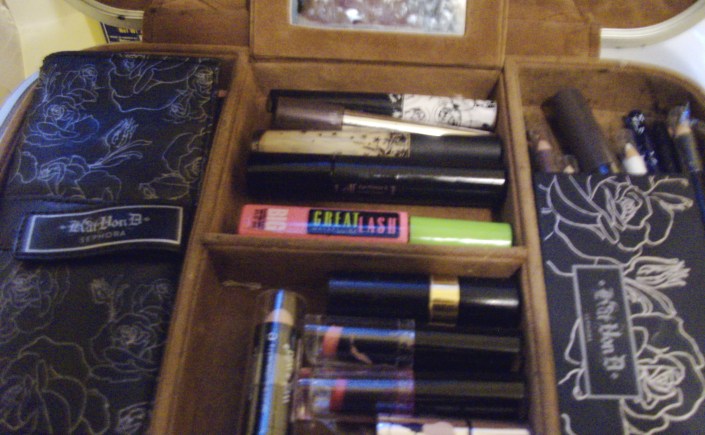
(Makeup) case in point: today’s picture. This is part of my daily routine. I love makeup. I love makeup like I love historical romance. I’ve got Kat von D. I’ve got Wet’n’Wild. They are usually on my face at the same time. There’s primers and color correction and a pleasing balance of neutrals and brights, accumulated from a lot of trial and error. Makeup is natural for me. I like it. It’s playtime. It’s not a mask, it’s art on my face. It’s part of me. Some women don’t wear makeup. Some men do. Yay for all of us, as long as the face we see in the mirror reflects the person behind it, I’m good with that. If I were to run errands or meet friends in jeans and tshirt and no makeup, I’d feel…awkward. Uncomfortable. Not ugly, just not-me. I spent too much time being not-me to willingly go back there again.

So it is with writing. All that striving and trying and bashing my head against the keyboard and shoving what I naturally want to do into a box because “real writers” do this or do that didn’t get me anywhere good. I’ve spoken before about writer friends, however well-meaning, who think I “really should” write their favorite genre instead of my own, or what’s popular or what’s hot or the next big thing. Stop. Just stop. If I wanted to, I would. I’ve tried genres that are not-me, and know what? They’re not-me. I’m me. I wear makeup. I write romance.

Creative exhaustion is something nobody plans on, but sometimes it happens. It’s not fun. It’s frustrating and annoying and something I wouldn’t wish on my worst enemy. It does, however, have the potential to be a useful tool. It teaches us what we don’t want to do. What doesn’t work. When we know what doesn’t work, we can turn in the opposite direction and go in the other way. Forcing writing very seldom works, and if it does, it’s not the same as writing that comes from a natural place. It’s easy to say “relax, it will come” and for those in the throes of creative exhaustion, that can make the pressure seize up all the more.

I’m not an expert, by any means. I still seize up at times over the fact that my most recent novel release isn’t all that recent :runs around in circles, screaming.: Must get new novel out now now now now now! Accio manuscript! :taps foot: Nothing? Guess I’ll have to do it the old fashioned way. Which is fine, because it can be a wondrous adventure.

Fumbling Toward Storytown

You should walk towards yourself as a writer, not away.
Chuck Wendig

Writer Friends: What are you working on right now?

Me: :shifty eyes: Um, :mumble mumble: New historical :mumble mumble: Georgian. :mumble mumble: Something about a love triangle. :mumble mumble: Canada.  :mumble mumble: Hey, look, a kitty.

Even if there’s no kitty. Really, all I want is to change the subject. Current Project doesn’t want to be talked about yet. Odd for me, since extrovert me really does want to talk to Everybody about pretty much All The Things, though I’ve tried really really hard to hold myself back on that. Sometimes too much. There has to be a happy medium, and sometimes it’s tricky to find. On the other hand, there is such a thing as talking too much about a story, so much so that A) It’s all talked out and now no longer needs to be written, and/or B) there’s so much input from so many different sources that outside voices drown out the voices of the characters. In either event, nothing gets done, and the characters sit around in the author’s brain, all crabby because they were all set to have this awesome adventure and now nobody’s doing anything and what are they even here for?

Imagine various couples dressed in garb from various historical eras, drumming their fingers on various tables, sighing loudly and looking out the windows because they are sooooo booooored. Not with being historical people (except for Anthony and Christine, whom I tried to shove into a Regency setting where neither they nor I are at all  happy, because Regency sells, but my heart wasn’t in it. We’ll give this a rest and try again in a different era when they are speaking to me again.) or with being couples, but with being stuck in stories that weren’t working because I was so determined to do things the way they “should” be done that I couldn’t have shipwrecked them worse if I tried.

Can they be rescued? Sure, most of them. We need some time to let the dust settle, these would-be books and I. Others will shake hands (or bow and curtsy as the case may be) and go our separate ways, glad to have been in each other’s lives for the good times we had. Time plus distance equals perspective, and taking a step back from a story-that-won’t is often the key to making it into a story-that-will, and eventually a story-that-did.

The story I’d thought I could maybe possibly have done and dusted, at least to the halfway mark, if I did do NaNo merely laughed at me. It didn’t want to be plotted with charts or GMC’d into marching order. No, these two have banded together and want to play with me. They’ll tell me this much, but I have to figure out this other thing before they’ll say anything else, but when I do, they have something special for me. I haven’t had a hero and heroine do this to me before, but that’s kind of the whole point, having those characters find me while I’m still wandering around in the woods at night, bumping into trees and getting my foot caught in decayed logs. One of them will help me sit on some boulder I never noticed before and the other one will calmly disengage my foot from the rotted log, chase off whatever wildlife was inside said log (because there usually is) and then we’ll have a talk. They’ll tell me their story and I will write it down.

Because that’s what it’s all about for me. The hero, the heroine, their story. All the rest, word counts and GMC and plot and historical versimilitude (far better than historical accuracy, but that’s another post altogether) and character charts and all the rest, those come secondary. Listening to too many voices has resulted in the past with me stomping about in the woods at night, during a rainstorm, with both feet in rotten logs and a bucket stuck in my head, and I’m over all that, thankyouverymuch. Here’s this couple (even when they unite to make me their plaything, but I’m not minding much, really; it’s fun for me, too.) and here’s me and we’re going on an adventure. Feels about right.

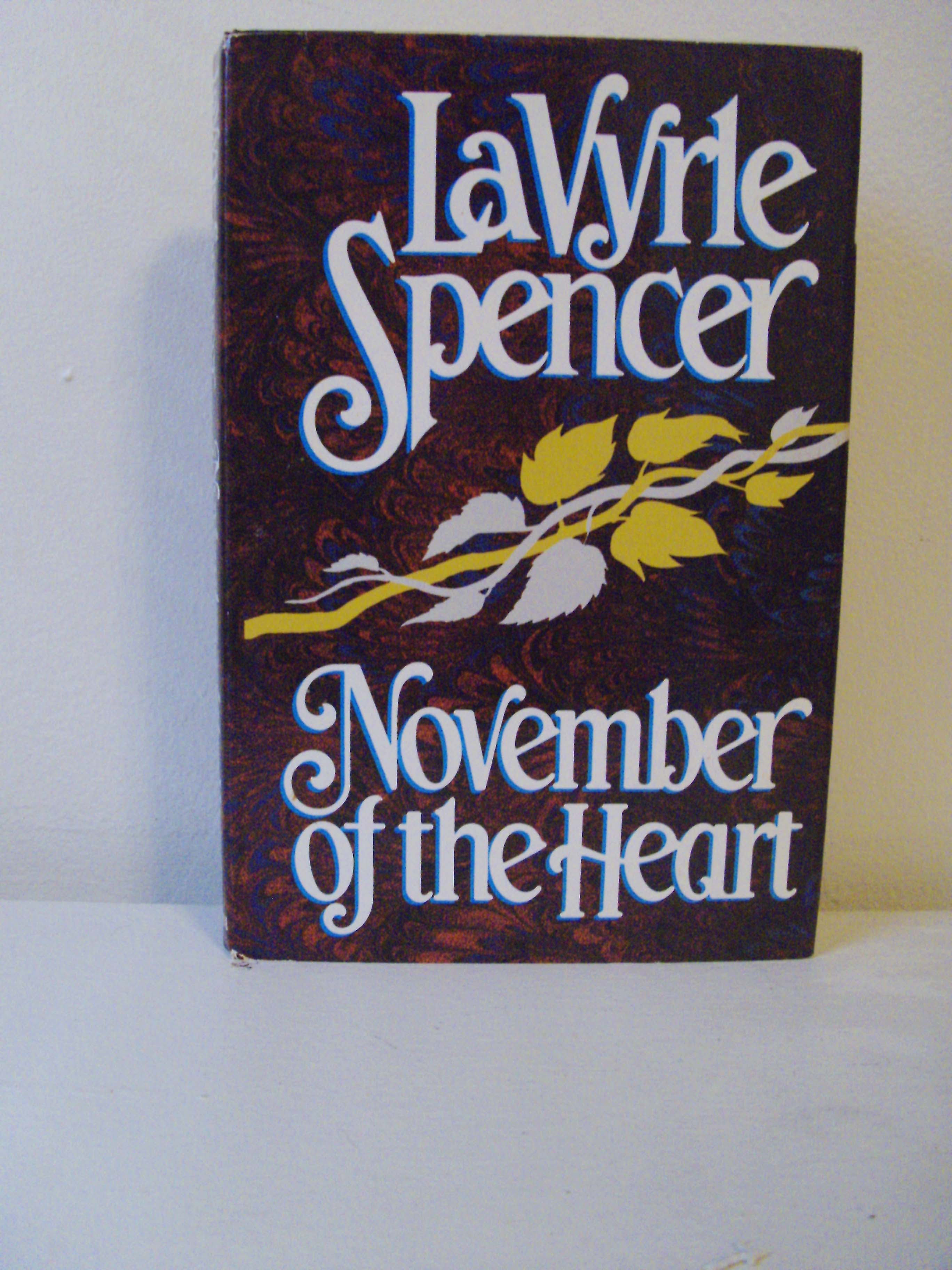
Throwback Thursday, Historical Romance Division: November of the Heart by LaVyrle Spencer

i1035 FW1.1

Out of all of LaVyrle Spencer’s books, and I have loved all of them that I’ve read, all of the historicals, and even dipped my toes into one contemporary, Separate Beds, November of the Heart is the one that sticks with me the most. That’s saying a lot. I have to confess, in the interest of full disclosure, that I have had more than one friend (two, at my best recollection) yell at me via email, because they didn’t know this book was going to have so many feelings. That’s why I love it.

One friend even said the title was “too sad” for her, but again, the title sold me right away. I love November, the month of coziness and deliciousness and giving thanks and  world full of color and scent and the holidays only a glimmer away. Turn of the century Minnesota is not an overplowed field in the historical romance world, and the all important annual regatta means everything to both the wealthy father of heroine Lorna and Jens, a boatbuilder pressed into service as a waiter. Slipping plans for a prize winning boat into one’s employer’s dessert is a recipie for disaster, but it also opens the door for a grand and glorious love that defies class barriers.

Lorna and Jens are star crossed lovers, Lorna drawn to Jens and his boat, their connection -it goes beyond attraction- gets tried by class, by time, by life, but when Jens and Lorna finally say the hell with everything that keeps them apart, I want to take a victory lap and toss confetti.  If LaVyrle Spencer ever wants to come out of retirement, I am leaving the porch light on for  her. If not, what she’s left us with is still magnificient.

Throwback Thursday, Historical Romance Division

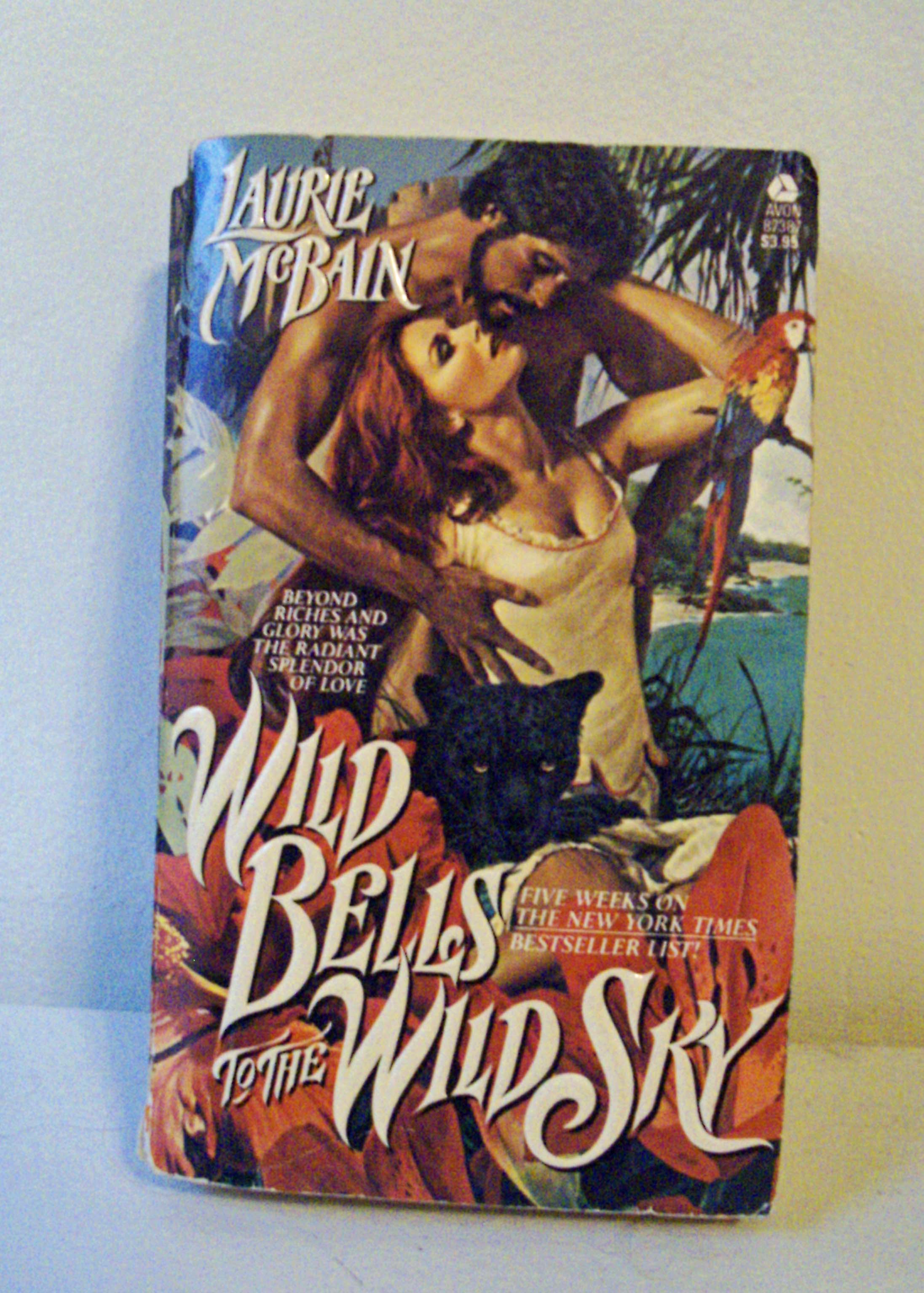
Wild Bells to the Wild Sky by Laurie McBain

Wild Bells to the Wild Sky by Laurie McBain

It’s that time again.  Wild Bells to the Wild Sky, by Laurie McBain, is one of those books. The all time favorites, the ones where I have only to hear the names of the hero and heroine -in this case, Lily Christian and Valentine Whitelaw, how perfect are those?- to immediately reimmerse myself in their romance and adventure. 

This book has huge servings of both. Set in the Elizabethan era, largely on a deserted island, Lily and her brother grow up wild and in seclusion. Lily, her mother, and a family friend are the sole survivors of a shipwreck, the sole inhabitants of the island…until mother and friend produce Lily’s brother, that is. Ahem. Then fever takes the parents, and Queen Elizabeth sends courtier Valentine Whitelaw in search of the missing party, and then things really get interesting. 

History, intrigue, romance, fabulous locations, a clever heroine and dashing hero, gorgeous descriptions, and one of my top five historical romance endings of all time make this book one I go back to time and again. 

Since we’re waxing nostalgic on Thursdays, here are a few recent things I’ve been up to: 

Guest Post at Savvy Authors: From a Certain Perspective, It’s All Fan Fiction: From Fan Fiction to Fantastic Fiction begins on September 1st, so I’m delighted to get to blabber about the useful tools we can find in the books, movies, tv and music we already love. Drop by and try a fun exercise to combine old favorites in new ways. 

Outlander “Sassenach” recap at Heroes and Heartbreakers: Cue incomprehensible squeeing, Jamie and Claire are now on the small screen, and I’ll be recapping each new episode as it airs. How cool is that, I get to watch Outlander and say I’m working. 

 1 Line Wednesday on Twitter, always a highlight of my week. 


What are you reading?