Happily Ever After, Epically Speaking

First and foremost, Happy Anniversary to Real Life Romance hero. Not our wedding anniversary, which is a different date, but the anniversary of the day we fell in love. We are mushy enough to remember the exact day (having it happen on a national holiday probably helped) and mark the occasion. I will not give the number of years, but I can say it was in another century, in a far off land called Santa Barbara. We were two college students, majoring in things that have nothing to do with what either of us are doing for work at present. Go figure.

This year, we marked the occasion with lunch at home, dragged out of the freezer and microwaved, because it’s the day before grocery day, and we both had stuff to do. Also because one of us cut the amount of bread in the household down to one slice while the other was off doing laundry. In a completely unrelated piece of news, a grilled peanut butter sandwich is apparently delicious but super melty to the point of liquefied peanut butter. I will not say which of us did what, because a good marriage always has some secrets, but it did end up with us dipping things in Malibu sauce (1/2 mustard, 1/2 mayonnaise, whisk together; excellent on chicken) at the kitchen counter and discussing what we thought life was going to be like cough cough years ago.

College majors, once of crucial importance, turned out not to be so much, in the end, for us. RLRH is now in the restaurant industry, and I make up stories, blabber about books, and tell people who kissed on TV. Living in NY state? We’d hoped. Now we’re doing it, in a beautiful apartment in a wonderful neighborhood we never want to leave. We share that apartment with Housemate, who knows all our dirty laundry and loves us anyway (or none of us can afford the blackmail; that’s also a plausible explanation.) Though I studied early childhood education, I did not take the degree, nor have I worked in that field since my last nannying gig in college. A few years in retail, many more in family caregiving, but the writing has always been there, even during the dark years when not much was actually coming. I did not expect those years.

RLRH and I went over a few things we would have never expected, if Present Us had been able to talk to Cough Cough Years Ago Us. Health issues, financial crises, deaths of parents and other loved ones, watching friends become parents, career derailments and changes of direction, changes of interests, the eclectic bunch of friends we’ve accumulated, a kitty who does not climb, jump or cuddle (but she does blog, so that makes up for a lot,) and other things we never would have thought of. We’d cut out on a school activity (not a class) that day, long ago, and threw off the person who’d gone out to look for us, because those two people on the athletic field looked like us, but he and I were not a couple, so that couldn’t have been, person kept on looking. We eventually returned to the event, knowing, from the time we’d spent soaking in the other’s company, that something was different, and always would be.

I’ve always known romance was my writing home. That was true back then, and it’s even more true now, maybe because I’ve lived the ups and downs of what life has to offer, with RLRH at my side. A lot of romances are courtship stories, maybe even the majority, and that’s fine. Falling in love is romantic, that’s for sure. Everything is new and shiny and overwhelming, and nothing has been like this before, and maybe, maybe…. RLRH and I threw around a lot of “did you ever think we’d…” questions to each other. Some were answered with “yes,” some with “no,” some with incredulous laughter, and, my favorite, a soft “I’d hoped,” from him.

That’s the other level of romance, and one I like to include in my books whenever possible. A lot of the current romances take place over a short period of time, so focusing on the courtship makes sense. That other level, though, the love that has been tried, broken, mended, grown stronger, as broken bones do, that’s also worth celebrating. Those stories also need to be told. That’s one of the reasons I’m studying some of the older historical romances these days, the ones with a bigger scope and taking place over a longer period of time. For me, the very best historical romances, the ones that linger with me years and decades later, are epics. Sagas. Romances worthy of historic record. Those make my blood sing, so that’s where my focus is going these days.

I once described an early work, which I still find satisfactory these many years later, as feeling like I was dancing in a room that was too small. That’s the best way I can put it, even now. I had a sense of restraint then, a keen concern about what I was “supposed” to do. Levels of historical accuracy (I go for verisimilitude now)  and sensuality and which periods are desirable and which are not. Word count is  a big bugaboo for me, useful in marketing and editing, but needs to be firmly locked away during the drafting process. I need to tell the story the way I tell the story and then we’ll focus on the form and all that during the next pass through.

Am I where I thought I was going to be all those years ago? Mostly, no. Am I where I need to be? Probably. Am I where I actually am? Most definitely. One of the questions RLRH and I asked each other was, did we think we were going to be this happy? Life isn’t perfect. It’s not ever going to be, and of course we have some what ifs, but we also have each other, and that’s what this happily ever after thing is all about, in life and in fiction. Onward we go….

Thursday Rambles

“Be willing to expose yourself to your readers. Plumb the depths of your own experiences and emotions in order to make your stories authentic. Don’t hold back.”

— Madeline Hunter

Wednesday’s post was going to be a special midweek update from Skye, but a domestic tornado chain touched down, here it is, Thursday, and Skye will be able to make her regular Feline Friday post tomorrow, so this one is all on me. Which would be lovely if I had any idea what I had planned to write here in the first place. Keeping the discipline of thrice-weekly blogging is one of my goals, so here I am, and my complete lack of focus means that I am going to babble and trust that some sense will come out of all of it at some point.

I will admit that, in a not that long ago romance writer’s conference, I had the great good fortune to be seated at the same table as Madeline Hunter at one of the meals, but did not get to talk to her. Despite my best attempts to peek at her name badge, I couldn’t get a good view, and the noise level was high, so shouting across a big round table wasn’t the most practical thing to do. Point is, I was at the same table with Madeline Hunter for an entire meal, and did not get to talk to her. This will haunt me to my grave. Either that or until my next opportunity, because these things do roll around again.

Granted, due to the lack of a clear name tag sighting, I didn’t know who the new arrival to our table was, and her only answer to a tablemate’s question of “what do you write?” (universal writer to writer icebreaker there) was “historical.” If I had known, I would have loved to talk with her. I still remember, long, long ago, when Madeline Hunter first came on the scene with well-received medieval romances, and feeling betrayed when she switched to Regency. I’m all for writers writing in different eras, and, in fact, I encourage that. I’d like to see more of it. What hit me hard at the time was the loss of a writer who used the medieval setting in all its grit and glory, leaving for more populated Regency assemblies.

There are multiple reasons a writer might switch time periods. Medievals have been declared dead multiple times since I started reading romance novels, let alone writing them. I don’t recall if it was that same conference, though it may well have been, where I pitched my own medieval, with a working title of Ravenwood, to a very interested agent, who said she loved my voice, quoted my own lines back to me, and assured me she would totally read this book for her own pleasure…but she couldn’t sell a medieval in the current market. Did I have a Regency?

I was working on one at the time, and told the agent that. She said great, send it when it was done, but don’t rush. She wanted the same level of polish as she could see in the medieval. Well, dear readers, I can say that I tried. I love the characters in that once upon a time Regency, love the conflict, love the resolution, but, as Critique Partner Vicki pointed out, I hate writing Regency. Georgian seems to be my natural default these days, so, when I do go back to that manuscript, everything will get bumped back a few decades, to fit within my natural reach. It’s going to take a while to get to that point, as I have the current novel and novella that need my attention, and I’ve blabbered on this subject before, so I won’t belabor the point.

Does this post even have a point? Does it need one? It’s written, that’s what, or mostly so, and I’ve had a few discussions, at various places on the interweb, about writing historical and how and why and all that. Defining what makes a particular period appeal to a particular reader or writer is far above my pay grade, so I’m not going to try (today) but here’s what I do know: I need to feel the era. To us, it’s history. To the characters, it’s life. Barring time travel (and I have a time travel waiting to burn off its own bad juju – this may be payback for all the jujubes I inhaled as a kid) the characters don’t know how the war is going to turn out. They don’t know they’re inching up on another ice age, or that the thingamahoozie is going to be invented two months hence, thus changing the world forever. They don’t know any of that.

What they do know is that they want the same things we do; home, health, shelter, food, companionship, purpose, love. All that good stuff. The way they get it, though, that’s where we find the differences, and what historical characters can and cannot do are influenced by any number of things. I find that endlessly fascinating. It’s easier for me to climb into a character’s skin and move around in their world if that world strikes a chord in me and plucks me like a stringed instrument so we can make beautiful music together. No doubt that can happen in any number of settings, and there are probably some I haven’t ever thought I’d employ that, someday, I will. For now, it’s Georgian, and, for today, that’s one blog entry down.

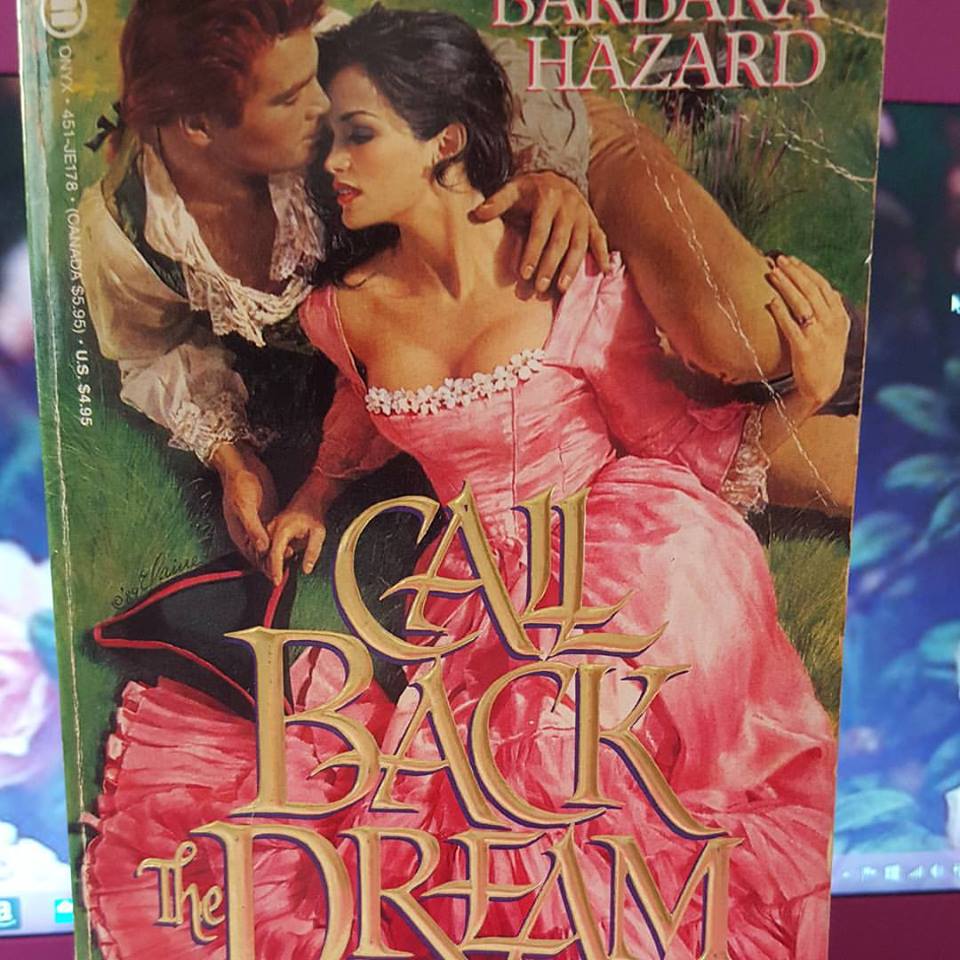
Order of the Golden Curtsy: Call Back the Dream, by Barbara Hazard.

Write what is wrong if it seems true to you and hang the critics of romance who would have it otherwise.
Judith Ivory

I have not read a lot of Judith Ivory. I intend to correct that. I’ve read some (and need to re-read that) but this quote jumped out at me, and it is extremely relevant to my interests at present. While it’s been some time since I’ve spent the majority of my writing time scrawling in endless notebooks about how I can’t write, want to write, need to write, but nothing is coming, oh my word, am I all done? Well, no, obviously not, because I would not have a writing blog if I were. I would not be filling out invoices for my work sold to other markets, and I would not be working on current novel, novella and other projects. At the time, though, it felt like it, and that’s a feeling I want to remember. Not relive, but remember, because it has a job to do.

Earlier today, I finished rereading an old favorite historical romance, Call Back the Dream, by Barbara Hazard, which I’ve talked about some before, and likely will do again. This book is one of the special ones, that has stuck with me through decades of reading, held up exactly as I’d hoped it would. It reminds me why I love reading and writing historical romance, and makes me excited to read its companion book, which I have recently discovered somehow got separated from its parent and is in storage. :sulk: No matter, I’ll pick another read from the same bookcase, though I can’t say which right now. What I’m going for is the feel more than anything else, the big, thick bug-squasher historical romance steeped in the spirit of the times (Professor Facos, thank you for introducing me to zeitgeist, probably the greatest gift a professor could give a writer of historical romance.) – the characters think, believe and behave as people of their time, and that drives the plot.

Call Back the Dream by Barbara Hazard

Call Back the Dream
by Barbara Hazard

I. Love. This. Book. So. Hard. It. Hurts. I highly recommend it to anyone who wants to know what sort of books I prefer to read, and, ideally, write, and will definitely read it again. During this particular reread, a new thought occurred to me: this book might not have made it to mainstream publication today, and if it did, there would likely be differences. Granted, there are fashions in writing, especially in genre fiction, same as there are in clothes, makeup, hairstyles, etc. It’s also true that publishing does go in cycles, so maybe some of the things that may read as dated now to the very modern reader may be all the rage next year.

Long separations aren’t common in many historical romances published today, but that doesn’t mean it takes away from the romance. Alexander and Camille are separated for fifteen years in this story, by parents who don’t take kindly to mixing classes, and both do marry other people in the interim. Reasons for and outcomes of those marriages make sense in Georgian England, and neither spouse is demonized. I liked that. When Alexander’s first wife dies, there’s pressure to seek another wife, as soon as possible, because he’s not getting any younger, and the title can only be passed down to his direct male descendant. This. Is. A. Problem. Alexander didn’t want to marry anybody but Camille in the first place, but he did his duty, and is willing to do it again. Well, to a point, that is, which I am not going to blab about here, because the scene where he Does A Thing out of strong emotion still makes my skin prickle merely thinking about it. That’s what I want to put into my books, too.

This is not a sexy book. There’s one intimate encounter between Alexander and Camille, and that not spelled out explicitly, but the strength of their love and the bond between them does perfectly fine without going into physical detail. It’s not a inspirational book, though Camille is a vicar’s daughter, her faith affects her choices, and we see her making observances of same. Her first husband is agnostic, and though it’s not gone into depth there, either, their differing views provide for stimulating conversations between the couple. Sex and faith both influence the plot but don’t dominate, though the love Camille and Alexander share, and its obstacles, do. When I read these pages, I ache for these characters and what they need to go through to achieve their HEA. I want to make that.

I love that, when Camille and Alexander do find each other after all those years, it’s not quick or easy. One of them is still married, for one thing, there’s a child involved, and both parties have huge paradigm shifts regarding things they thought they knew beyond any doubt. There’s anger. There’s betrayal. There’s an offer nice people don’t make. There’s consideration of that offer, and consideration of what acceptance of that offer would mean to other people, on an intimate and grander scale. I want to suck this in and soak in it and breathe it and learn from it and make it mine.

There are some books that we read. There are some books from which we learn. There are some books in which we see ourselves, as we are or as we would like to become. Long ago, I had the idea of starting a feature, on my previous blog (or the one before that?) to ramble about my favorite-favorite historical romance novels, but I never did it. No idea why, but no time like the present, and so I induct Call Back the Dream by Barbara Hazard as the official first member of the Order of the Golden Curtsy. Time to show respect to a mistress of the genre.

Back to Old School Season

Last night, the power went out. Twice. The night was sweltering hot, the rest of the family had sequestered themselves in their rooms, hot and cranky, leaving only me out in the living room. My plan was to watch Ink Master (which I am not sure even recorded, but there’s always On Demand, right?) and write, but BAM, the big dark. The box fan went out. College kids (we live in what’s termed the student ghetto, as our neighborhood hosts multiple institutions of higher learning) whooped and hollered, and one fine citizen decided that was the perfect time to shoot off fireworks. Really? Why do you have fireworks in September, sir or madam? Waiting for exactly this sort of event? Can’t make this stuff up, and, being a writer, that’s kind of my job.

So, anyway, there I am, in the dark, faced with a giant shift in plans for the evening. I don’t have tattoos myself (and can’t, medically, as I have eczema, which does not play nicely with tattoo ink) but I find the art form fascinating, so tattoo shows are must-see television for me. Ink Master is my favorite. This season is masters vs. apprentices, which I think is an interesting concept, especially how each pair handles the competition. For my money, if I were the master and my apprentice surpassed me, I would consider that proof I had done my job well. The student should surpass the teacher, IMO, at some point. That’s how we improve.

Which is where we’re going with this, today. After batting around some email conversations with writer friends, I dragged the window seat cushion onto the floor, filled my travel mug with ice water and settled in beneath the living room window, to hug an ice pack and have a good think. I would have written this out if there had been any light to speak of, but there wasn’t, so I’ll get it down here.

The office overhaul has brought a few different things to mind, notably my reading habits of late. While I do have that lovely TBR shelf above, where my brain and heart keep going is over two shelves, to the recently unearthed classics in their new case. Valerie Sherwood, Laurie McBain, Anita Mills, Barbara Hazard…I have  missed those gals and the stories they told. Not all of them would appeal to the modern reader, but they have stuck with me over the years, and in some cases, decades. The question is, why? What grabs me that strongly, for that long? Good questions, and there’s only one way to find the answers. Study the masters. I’d say mistresses, as, with the exception of Jennifer Wilde (who was Tom E. Huff in his private life) these books were written mostly by women (though Laurie McBain relied on her father’s input, and Valerie Sherwood thanked her husband, Eddie, for his role) I’m reluctant to use the term “mistress” in this context. Whole different profession there.

There hasn’t been a lot of reading time lately, but, once I started my reread of Call Back the Dream, I noticed I was approaching a few things differently. Right before the lights went out, I’d sneak-read a chapter in the bathroom. Haven’t done that in ages, but I used to do that all the time, when I couldn’t wait to dive back into the world of long-ago lovers. There was what we’d call head hopping today (I’m not going to go into putting modern standards of writing onto writers who worked when conventions were different, as that was how things were done then, so shushies) but the details…wow. I felt like I was seated at that table in the vicarage, having dinner with the heroine’s family. Each sibling, both parents and even their lone servant were distinctly painted characters, and no, they do not all get their own book. Sometimes, supporting characters are just supporting characters, and that’s okay.

I’ve read this book before, and will read it again. There’s the delicious sense of anticipation, because I know what Camille is going to find in a certain spot by the stream, but she doesn’t know that, and neither she nor Alexander have any idea what that spot is going to mean to them, or how long it’s going to take before they can claim the HEA that they might have had that much sooner if a few things had been even the slightest bit different.

Different. That’s the word. I love the historical romance genre; that’s what I live and breathe, what I’ve read and written since I was but a wee princess myself. I love that there is something for everyone, and I love that I do have these books from the era of my reading career that fires my blood, in which I see myself and the stories I have to tell. That’s in both senses of the word; one, that I possess them, and two, that I need to release them into the wild. I want the bigger stories. I want the variety of historical settings and eras, and people who think, act, speak, believe and comport themselves as people of their time. Not so much textbook-strict accuracy but versimiilitude. Could it have happened? If so, bring it on. Even so, I’m not writing a textbook, and I’m not writing fictionalized biographies. I’m writing historical romance. The love story has to be as important as the world in which it takes place, and it has to be done in such a way that it could not have happened at any other place or time.

The best way for me to learn how to do this is to see how it’s been done, and them replicate it, in my own voice. Which means I’ll be reading through these keepers, balancing the classic romances with newer editions and learning from both, to make something entirely new. Teacher may be a strict one in this class I’m making for myself, but at least I’ll know attendance will be one hundred percent.

Post Labor Day Rambles and Georgian Unciorn Chow

Monday’s post on Tuesday does not count as late if Monday was a holiday. Not sure if a holiday counts as such if it’s as disgustingly hot as this one was, but I got to spend Sunday with my good friend, Mary W, and her hubby :waves hi: so that definitely gets holiday points.

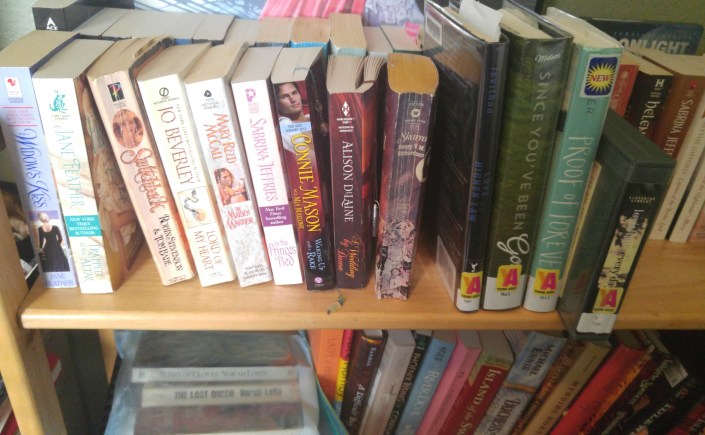
In preparation for the visit (and because it had long since fallen into ‘high time’ territory) I hauled a mostly unused bookcase into my office and busted my special keepers out of the storage box where they’d been since the big move and got them out on display.

Shelfie!

Shelfie!

Getting these old favorites out of mothballs and out where they can see them gave me a jolt of energy. This is why I read and write romance. If some of these books look well-read, it’s because they are, studied as much as read for pleasure. Those Valerie Sherwood books? Saved my bum in a pre-Revolutionary history final in college, where I needed to detail the contributions of three ethnic groups other than the English, that were essential to the survival of the colonies on an economic level. First two that came to mind were easy; indigenous and African, one group here already, and the other not here by choice, but both contributed much. Then my mind skidded to a halt. Sure, I’d studied, but could I remember any of that? Nope, what my brain wanted to  hang onto was that scene in Bold Breathless Love, where the heroine escapes her abusive husband by ice boat on the Hudson Riv…waaaaait a minute. Creepy abusive husband dude was Dutch, and so was the ice boat, and ice skating, and those were pretty darned useful, because otherwise, there is zero river commerce during the winter months, and then how are we going to get goods from producer to consumer, hm? Ice, ice, baby. Bonus points for those who know the legal name of the gentleman who popularized that phrase is Robert Van Winkle.

There’s a lot to be said for getting in touch with one’s bookish roots, and it’s a practice I highly recommend. Though I haven’t been reading a lot of current historical romances lately, merely seeing these books on shelves made my reader heart go pitter-pat. I want to reread that one and that one and that one, and ooh, that one. The array of settings and eras here dazzled me then, and it still does. 19th century Russia? English Civil War and Restoration? Georgian England? Colonial America? Yes, yes, yes and yes. This is a shelf full of unicorn chow, and I couldn’t be happier to have it out in the open again.

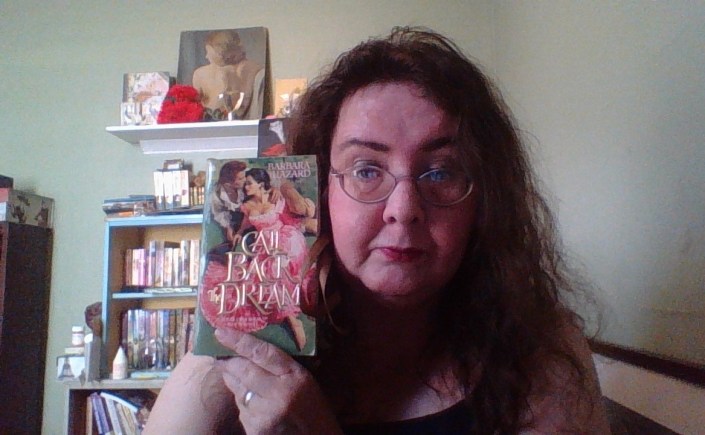
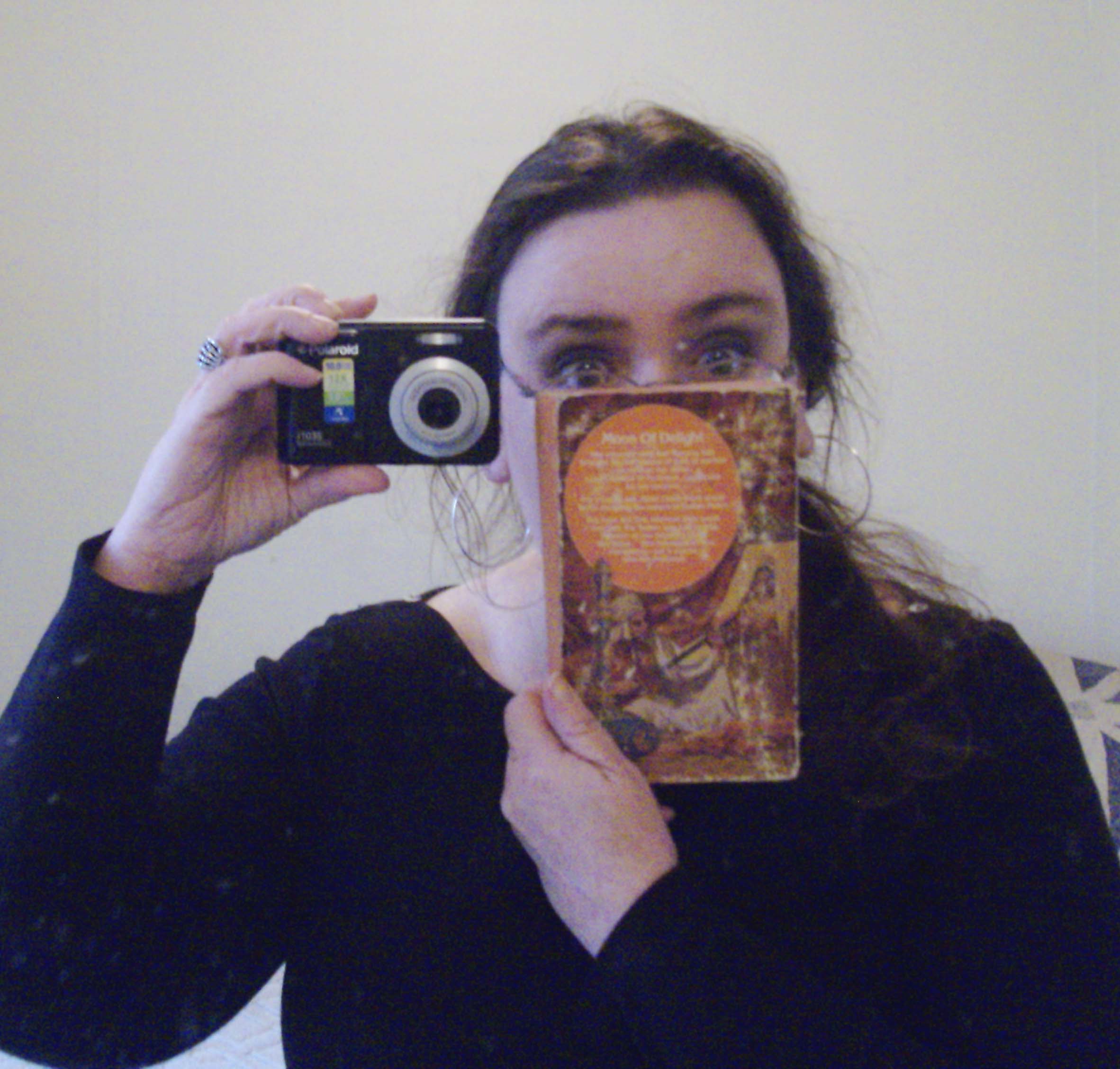
The book I’m holding in today’s picture is Call Back the Dream, by Barbara Hazard. It’s the first book I ever wrote a fan letter after reading, and I still remember being gobsmacked when Ms. Hazard actually sent back a personal reply. Not light reading, by any stretch of the imagination, and those brave enough to crack that gorgeous Elaine Duillo cover are going to need Kleenex and possibly counseling, because man oh man, the emotions here, and they are directly dependent on the historical world in which Camille and Alexander, the lovers depicted in said illustration live.

No rubbing of elbows with the movers and shakers of the time, but two star crossed lovers from different classes that society has decreed do not mix. Camille is the daughter of a vicar, Alexander the son of an earl, and those readers with some familiarity with the way things worked in the middle of the eighteenth century know this is not going to be an easy road. It’s not, and that’s what makes it a darned good story. Marrying other people? Well, duh. Secrets and lies? Um, yeah. Matters Need to Be Dealt With because those crazy kids and their radical ideas do not jibe with the Way Things Are Done. There’s breeding to consider, in both senses of the world, and the road to happily ever after takes Camille and Alexander fifteen freaking years to traverse. Yeah, baby.

Make no mistake, they make it to their mountaintop, but there are Ramifications, which Ms. Hazard further explores in the sequel, The Heart Remembers, which puts Camille and Alexander’s natural son, Jack, in the spotlight, after he finds out the way his family tree is really rooted, and he does not take it well. I’ll be rereading that one after I reread Call Back the Dream. I did write Ms. Hazard back and ask if there was going to  be a third book, to bring certain events full circle, and, though she allowed I was right about certain things, wasn’t sure if the book would be written. To my knowledge, it has not, and, believe Ms. Hazard is not currently writing, unless it is under a pseudonym. If so, I want to know what it is, because I will read those books.

These books get unicorn chow points because, double-digit years after first reading them, I remember, vividly, specific scenes. Camille’s first appearance, doing laundry on a hot and humid day, the books (Pamela, by Samuel Richardson) Alexander left for Camille to read in secret, The Fire. Those who have read this book know what I mean, and those who haven’t, you’re in for a treat.

That’s the kind of book I want to produce, so that’s the kind of book I need to make sure I’m taking in, as often as possible. Reading these books reminds me why I’m doing what I’m doing, and makes me want to do everything I can to earn my own books a space on that shelf. Ms. Hazard, wherever you are, I’m leaving a light on for you and setting a place at the table.

As the Unicorn Rambles

All right, my liebchens, it’s Wednesday, I’ve already done #1lineWed on Twitter, I have a chat with my fabulous critique partner, Vicki, at two, writing must be done, articles pitched, so you’re getting this ramble because that’s how I roll.

Thanks to friend and reader Mary W, I got the idea to talk about some of the books I’ve read, recently or otherwise, that do suit my tastes. Much more fun to enthuse over something I love than whine about trying to find more of it. Here’s the thing about that; some of the time, it finds us, so all that looking can, in those cases, be the same as smashing our heads against a brick wall in hopes of getting through it, when, if we’d kept on walking a few more paces, we could have found the door, garden gate, etc.

This was going to be a video post, but the cold sore that showed up overnight is not terribly photogenic, so you’re getting this instead. All righty, disclaimer aside, let’s jump into this.

i1035 FW1.1

Yeah, yeah, big surprise, but hey, reissue cover, for variety’s sake

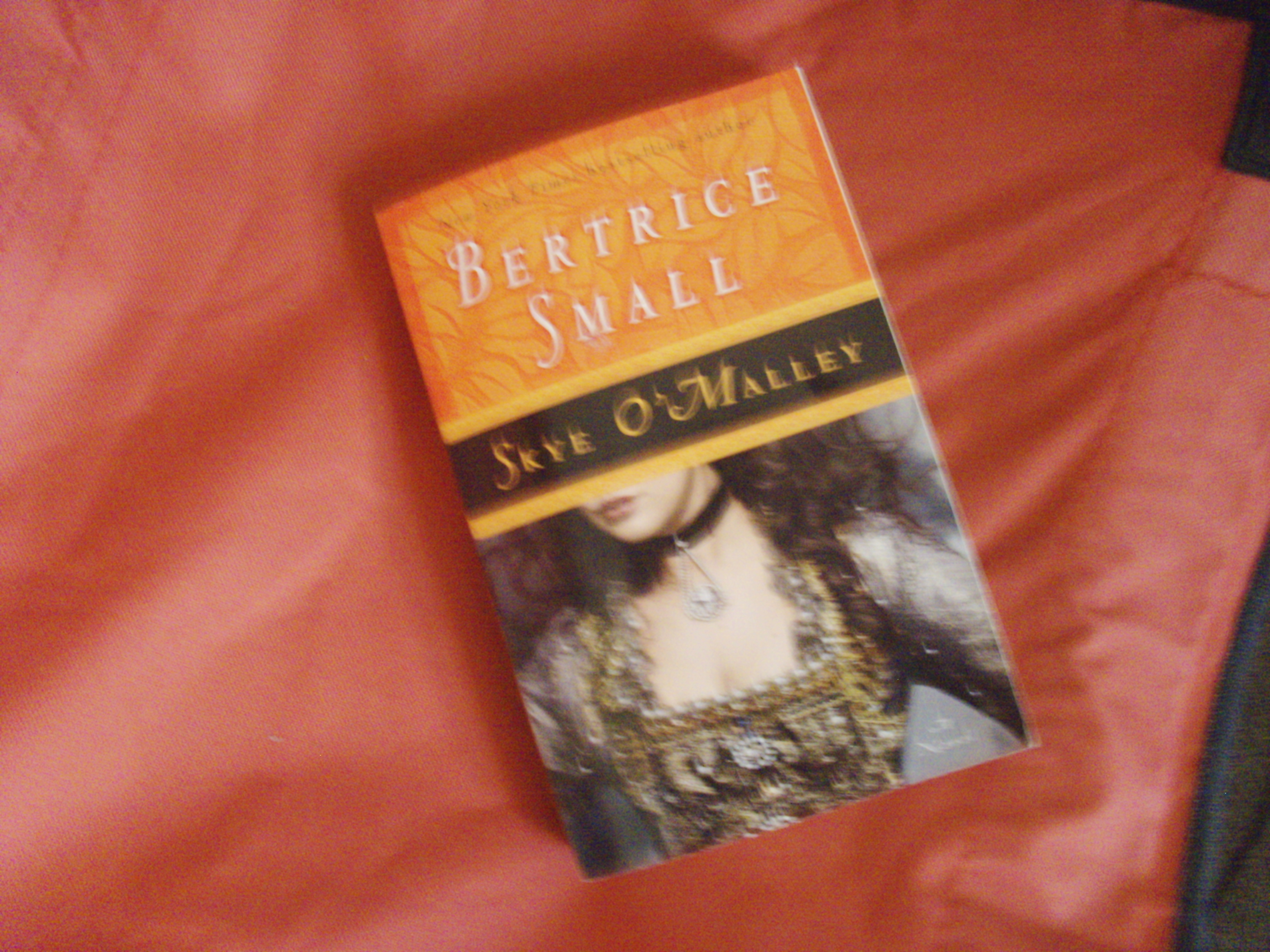
Skye O’Malley, by Bertrice Small
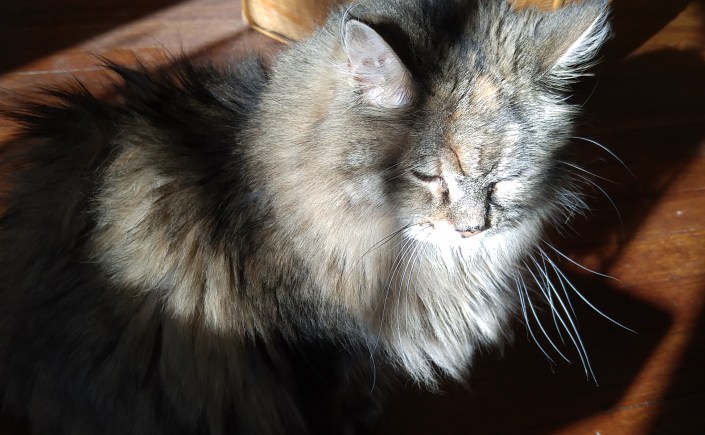
(the book, not the kitty)

This is my all time favorite historical romance novel, big, bodacious, sprawling over years and continents, with one kickass heroine who doesn’t let boys boss her around. Doesn’t let Queen Elizabeth I boss her around either, for that matter.  An instance of amnesia actually working in fiction, lots of grit and adventure, from sixteenth century Ireland, England, Algiers and the high seas, to the political machinations of a woman making her way in a man’s world on her own terms, this gets my story blood pumping.

As for romance, Skye has more than one love in this book, and I am okay with that. Niall, her first love, and the hero of the book, is my favorite, and that final scene where the two of them and their friends literally do ride off into the sunset, well, that’s my all time favorite romance novel ending, ever. Yes, I can recite it from memory.  Much bigger in scope than is currently in vogue, and I miss that scope, this takes Skye from her birth to her HEA (for this book; eleven others follow, chronicling Skye’s family’s adventures) and set the bar or the larger than life heroines I prefer.

For those keeping track of that sort of thing, yes, this is a sexy book, but please don’t think that’s the whole point.  The character shine here, as people of their time, and if you don’t want to stand up and give Skye, Niall and company a fistpump at the end, well, I don’t know if we can be friends. (Okay, we probably can, but I would hold it against you. I am bribable with gummi bears, though, so you may still have a shot.)

Sword Dancer, by Jennifer Roberson

Oh good gravy, this book. I resisted reading it for ages (E, how long did I avoid this one?) because I’m not into a lot of fantasy, but, trust me, this really really is a romance.  Famed warrior Tiger can be matched by no man, but (fantasy readers, you know where I’m going here) that’s kind of moot because Del is no man. From the first time the two meet, in a desert cantina, the chemistry crackles between this Southron (sic) alpha male and Northron (sic) woman who is so very much his equal and opposite that following them through seven (so far) very thick books is not nearly enough. I also know the last line of this seies by heart. It was everything I …er, he dreamed when he slept at night, among the salset. :happy sigh:

My copies are in storage, but I have written about the series for Heroes and Heartbreakers, here.  Yes, there’s magic in this book, and it’s told in first person, from Tiger’s POV, but this gal found it very easy to slip inside his head. Tiger thinks he’s tough, and he is; he earns a living with his sword, fending off challengers, but the challenge he didn’t expect was to find a woman who can do what he does…and more. Del needs Tiger’s help to find and free her enslaved brother, This relationship has a lot going against it. They’re literally from two different worlds, and each gets a chance to see exactly what the other has had to overcome in their hometowns, not to mention some huge challenges destiny throws their way. I won’t give away their secrets here, but if you want a ride or die couple in your romantic fiction, Tiger and Del are it.  This really does read like a powerful historical romance set in a place we don’t know yet, so if you’re hesitant about fantasy, this is  good place to start. Ms. Roberson has also written some excellent historical romances, so, y’know, precedent has been set.

Eleanor and Park, by Rainbow Rowell

Not historical romance, this one, but, well, kind of, sort of, in its way. Set in the 1980s, we could call this a period piece, because the fabric of the time is essential to the romance and shapes it in a way that one would collapse without the other.  It’s standalone, too, which is one thing I sorely miss in today’s market (though I find more standalones in YA than historical romance; what’s with that?) and absolutely everything revolves around the love story.

Eleanor and Park, high school students, meet on a school bus. Eleanor is hard to overlook. She’s fat. She has big, curly, red hair. She dresses funny. Park doesn’t want the trouble, but when he sees how badly she’s getting picked on, he reluctantly lets her share his seat. Then he notices she’s reading his comic book over his shoulder. He holds the book open wider so she can see. Swoon, right? He gives her the book, and other books, makes her mix tapes, becomes the one pure and true and good thing in her life. Eleanor needs that, as her home life is a crazy free fall of chaos with her abusive stepfather and her gaggle of siblings who look to her more than their parents for stability. Park’s family has romance cred already, as his dad loved his mother enough to go back to Korea for her, and he knows what love looks, feels, and sounds like.  He knows he’s found it with Eleanor, and he’s willing to fight for her, literally and figuratively.

The course of teen love never does run smooth, even though both know this is the real thing, and both must make a heartrending choice when Eleanor’s home life escalates. I do count this as a happy ending, and I like to think I do know what those mysterious three words in the book’s ending are. I will fight those who disagree, because, yeah, that is the hill I want to die on when discussing this book. I’ve written about Park and my other favorite YA book boyfriends for Heroes and Heartbreakers here.

That’s all the time I have for today, so I shall leave you here and scarper off to Georgian England for a while. What books can get you squealing like an excited fangirl/boy? Can you tell anything these three books or their characters have in common? Know a good cold sore remedy? Drop a line in the comments and let me know.

Rambly Ramblings on Writing, Reading and Feeling Like a Unicorn

“Trying to write about love is ultimately like trying to have a dictionary represent life. No matter how many words there are, there will never be enough.”
David Levithan, The Lover’s Dictionary

Not sure what I want to talk about today, so you’re going to get a freeform ramble, and I am going to trust that I am going to make some sort of sense by the time I’m done. This has been not exactly a domestic tornado day, but it has been a day with a full house, interrupted by Real Life Romance Hero and Housemate heading out a deux on a grocery run. Insert Rant of the Lonely Extrovert here, because even though grocery shopping with the whole household (minus Skye, who stays home because she is smart and also a kitty) can make me crabby at best and anxious at worst, it’s still out of the house and being around people. Alas, being sun-sensitive won out, because it is blindingly bright out there for those of us (aka me) who are pale and not suited to summer, so I am rambling from my favorite seat at the coffee house down the block from our own abode. It’s nice and dark here, within the exposed brick walls, I have an iced smoky chai in front of me, am functioning remarkably well for someone who has been Mentos-free for over a week and it’s time to take a look at the week ahead and what I am going to do with it, writing wise.

At the moment, I’m at the “staring at the twenty-foot high blank white wall” stage, which is not at all uncommon for a Monday, and I know that it does, indeed pass, so not going to stress about that. Note to self: writing about things that do not bother me all that much does not make for sinctillating interesting reading. If I am making myself yawn reading it, then it’s probably going to elicit the same response from readers. Which is not at all what a writer of commercial fiction wants, by any stretch of the imagination.

Had a train of thought there, but lost it. I hate when that happens. I am going to blame the upset to routine. My ideal method of attack is to make a list over breakfast, prioritize, then do all the things, crossing them off as I go. That did not happen today, and I am feeling the lack. I am also feeling vaguely unsettled that three passes through the main library’s romance section did not yield anything I had to take home with me right that second, but I was able to cull an armful of fresh voices and intriguing situations from the YA shelves in a matter of minutes. Under one, actually. I wasn’t counting. After devouring the realm of possibility and, earlier, How They Met, and Other Stories, both by David Levithan, which were a master course in romance (even if some of those romances don’t end well) and emotion, I had decided I’m going to have to devour everything he’s ever written and see what I can mine from it. If this guy can tell a love story entirely through dictionary entries, that definitely counts as innovation.

That innovation was what I found myself hungry for when I scoured the romance shelves. Historical romance is still my genre. It’s still what I love to read most, and what I love to write, and, at the moment, it has me somewhat itchy. Not sure what this is, but acknowledging this itchiness is important. Today, looking at the shelves, I saw, with the exception of older titles, almost exclusively series. I get the popularity there, I really do. There’s a built in following for many writers that way and many readers like the comfort of returning to a known community with familiar characters and such. I do follow some series, but not because they are series. There has to be something else. When I write, I naturally think in standalones, which can make me feel, at times, like a unicorn.

I see a lot of Regency settings. I’ve tried to write Regency. It did not end well, for anybody involved. My critique partner, Vicki, summed it up best. “You hate writing Regency.” She’s pretty smart that way. I do. Perfectly fine historical era, but where other writers get excited about Almack’s and, um, Empire waists, I get nothing. Dial things back a couple of decades to the Georgian era (yes, yes, I know, the Georgian era technically goes up to the coronation of Queen Victoria, but my blog, my rules) and we’re talking a whole different story. Wigs, high heels, embroidered satin, painted fans, makeup that would make Kat VonD jealous, and then there’s the women.

The historical fiction shelves (and boy howdy, do I love that our library system has a special sticker for book spines to designate historical fiction) get my interest from time to time, but my problem there, and I do love historical settings best of all -plop me down anywhere from the end of the Wars of the Roses to the end of the American Revolution and I am one happy camper- is that fictionalized biographies are a very hard sell for me. (Unless the topic is Anne Bonny, in which case, give, and back away slowly, mama’s reading) I’d rather read about original characters living in that world than the actual figures, though the actual figures can serve in supporting roles. I saw a few titles that looked mildly interesting, and I do know that some older historical romances of a few decades past have had second lives repackaged as historical fiction, as have some of the authors of such, but…

…that’s where things get unicorny. I want something new, within my favorite genre. Give me one hero and one heroine, in a fully realized historical world, make them people of their time, take me on an adventure and deliver on that big happy ending. Along the way? Carte blanche. (Yes, yes, I know, technically Regency term. Refer above; my blog, my rules.) The best way to make that happen, I know, is to write it myself, and I’m working on it, but there are days when I wouldn’t turn down the opportunity to stab things with my sparkly horn for a while.

This may have been one of them, but that’s where the discipline of routine comes in. Monday’s post goes up on Monday. So, here it is. It’s okay if I ramble, because rambling will take me somewhere that stewing will not (and also, I hate cooked carrots, which stews often contain.) I don’t think I’m done yet, but I do have a date with my plotting board and some sticky notes, so wrapping things for now. See you Wednesday,

Random Monday Blatherings – Jump in and Do It.

In my continued determination to keep blogging on the days I have blog entries planned, I am here. Random picture of moi as your image, taken in afternoon light at my favorite seat in my favorite office away from office, Hudson River Coffee House I love that place. Love it. Cool in the summer, warm in the winter, exposed brick walls, friendly staff, excellent tea, excellent food, the owner sometimes brings his dog (can it be considered a pub dog if it’s not a pub but a coffee house?) My tablet still doesn’t want to connect with the internet there, but my phone and my laptop do, so I think I can deal. Not heading there today, because it’s approximately a thousand degrees outside and my pale, sun sensitive self has already been roasted, including my brain, which is why you are getting this ramble.

You are getting it in text instead of video because humidity has not been nice to hair or makeup today, and because I want to make sure I get at least one non-Skye text post per week. Goals, people. They work I like organization and planning. Getting a big furry mess of chaos into shape and  ranked in order of importance always makes me happy. Having a plan means less uncertainty, and gives me a road map.

So why, then, is this a post about jumping in and doing stuff? Doesn’t that go against the whole plan thing? As it turns out, nope. As I’ve said before, my favorite pieces of writing advice from K.A. Mitchell never fail.

  1. open the file
  2. change your seat

Those have not failed me yet. When I don’t know where to start, that places all options as equal (at least in a certain regard) so the first thing to do is make a decision. I am doing something. I am doing this. What the “this” is can vary from day to day. Today, it’s jump in and write a blog entry. Write a blog entry on writing. What counts as writing? Well, writing, duh. That thing I do with my brain and English and some sort of method for preserving what my brain does with the English. Right now, at my desk, I’m looking at the colored index cards I used to give my On Beyond Fanfic presentation, because I’m going to need them for Play In Your Own Sandbox, Keep All the Toys. Which may need some sort of abbreviation. PIYOSKATT? Sandbox? I’ll get there.

I also have the neon green legal pad with similarly eye-searing but different-hued sticky notes on which I am figuring out the layers of a love scene from the hero’s POV. Love scenes are hard, y’all. Up until recently, I didn’t write them. Call it a case of the “shoulds,” but then I had two characters (Angus and Summer, from ye olde time travel) who blew right past me and wouldn’t let me turn the camera away, because that was some character development going on during that intimate moment and that changed things. When I do get back to Angus and Summer’s story, I’ll be starting pretty much from scratch (have to sweep out all the pesky shoulds) but I know that scene will stay, and probably stay pretty much intact, because it feels like them.

Every couple, and every story is going to be different, because they have their own histories, backstories, insecurities, wounds, hopes, how they’re reading and misreading the other. There’s what’s going right and what’s going wrong, what else is going on around them both internally and externally, and that’s not even taking into account who has what where and when. I use a lot of sticky notes, and I prefer to concentrate more on emotions than body parts, though those certainly do come into play. Like I said, there’s a lot here to choreograph, both physically and not, and maybe the sheer amount of things going on could be one of the reasons I held back on this front at first.

Not to say that all romance novels have to have explicit sex. That’s certainly not the case. Inspirational, sweet, YA, (most) traditional Regencies, etc, prove it’s not a prerequestite. I don’t like the term “clean,” because I don’t think a book that does keep the camera rolling during intimate moments is automatically  “dirty.” I think there’s a lot more to it than that. Authorial intent goes a long way. For me, it’s a matter of staying true to the characters and their stories.

In the end that’s all we can do. Tell our stories, and tell them the way they come to us. For me, that’s usually in longhand, with bullet points, lots of crossing out and layer upon layer.  Sometimes, the first thing that comes to me for a scene is something in the middle, so I go with that. What happened before and what happens after, I can figure out. Hero has a limp now when he didn’t before? Okay, how did he get that? Heroine can read and write in a language I never planned for her? Fine, where did she learn? Instead of fretting about fitting things into somebody else’s system, I find what works best for me, at least right now, is to pick a point to jump in and then splash around. The order will present itself, as long as I show up and get my hands dirty. That, I can do.

…and we have blog entry. Looky there. See you Wednesday, Liebchens.

Typing With Wet Claws: Historical Versimilitude Edition

Hello, all. Skye here, for another Feline Friday. Things are taking a definite swing toward fall this week. The sidewalk part of the construction is finished in front of our house, so it is not quite as noisy and the floor does not shake as much. Anty is very happy that there is actual sidewalk now, so she can wear heels when she leaves the house if she wants to, without risking ankle death. Construction is not completely done, as they still have a giant pit in front of the house next door, and we still have new trees to be put in where the old trees used to be. New trees means birdies will come back. I love watching birdies in the morning, so I am excited about that.

Anty does have a funny story about the day they poured the cement, and she said I can tell it, because it is really about me. Uncle was home until dinnertime that day, so Anty went to write at the coffee house. When left the house, she noticed that there were big mesh things laid out in a grid pattern on the gravel in front of our door. That told her they were probably going to pour the cement soon. She did not know how soon, because, when she got home a couple of hours later, there were men in big rubber boots almost to their knees, spreading the cement around. I should mention again that I am an indoor kitty, and Uncle had already left for work.

Anty was very concerned about being able to get in and take care of me. There was cement everywhere, and the workers were not happy about having to find a way for her to get across. One of them asked if she could please use the back door (I do not think he said please.) Anty said that she could, but she would have to go into the back yard (it is really tiny, because we live in a city) to get to the back door and the gate to the back yard is right next to the porch, so she would have to get across the wet cement sea anyway. The workers grumbled about having to put boards across it, but then she said the magic words. She had to get inside and feed the kitty (I am that kitty.)

Well. The workers put two boards up, side by side, and let her hold their hands so she could keep her balance as she walked across them. Anty thanked them and came inside. I got my meal (it was cat food, which is my favorite) and Anty got some more writing done. I love a story with a happy ending.

So does Anty, which is why she writes romance. She started reading romance when she was still a person kitten, only eleven. That first book was The Kadin, by Bertrice Small, and she knew right away that she had found what she wanted to read and write for the rest of her life. She says so far, so good. Anty may give the humans in her books a lot of problems, but, because it is romance, she fixes them by the end. Reading romance novels written by other humans is something that Anty loves  do, but has not had a lot of time for this summer, but now it is almost fall, so she is looking at reading more romances, especially historical ones.

Anty says recommendations are welcome...

Anty says recommendations are welcome…

Some humans like their historical romances to be what they call ‘wallpaper.’ This term confused me at first, because I thought it meant that they took the pages out of their books and covered their walls with them. I guess that is one way to go, but that is not what it means. A ‘wallpaper’ historical romance means that there is very little detail given about the period in which the book is set, only enough to give some flavor. Anty does not do that.

For Anty, the best books to read, and the ones she likes to write, are the ones where the historical world and the romance are intricately intertwined and one could not be the same without the other. This does not mean that she writes about humans who actually lived in those other times, but things those humans do did affect the people around them, including the ones who live in Anty’s head. She wants to know what it is like to slip inside the world in which her story people would have lived, and see the world the way they would have seen it.

Since Anty has not, to my knowledge, mastered time travel (but Uncle says it is okay if she gets in a blue police box if it comes) this means she has to find other ways to know these things. Some humans like reading books (that are not fiction) to learn more, and Anty does that to some extent, but what she likes to do the most is get hands on experience. Living history museums and historical reenactments are her favorites, as she can pick up on details that books may miss. She likes to know for herself what a shipyard smells like, for example, or how heavy a musket is in her hands. She once talked a blacksmith into letting her come right up to the forge, which most guests do not get to do, but Anty has special writer powers. Watching period dramas is also good, because watching people move around in the clothing of a different time tells her more than looking at a still picture, even though portraits from a particular era are the most reliable source of how clothes actually looked. She also is quick to point out that, while things like white wigs and high heels on men look funny to modern people, in the times they were worn, those things were hot stuff, so her book people would probably like them. Then again, it all depends on the characters.

Anty is now making throat clearing noises, which means that has to be about it for this week. Until next time, I remain very truly yours,

Skye O’Malley Hart-Bowling
(the kitty, not the book)

Until next week...

Until next week…

Remembering Bertrice Small, Part Two: As a Writer

Bertrice Small was the first professional writer I met in person, and long before I knew that writing stories of loves long ago even could be a job, but as soon as I figured it out, I knew that was what I wanted. I never had anything but support from this lovely lady, even when that support took the form of tough love.

The summer I was sixteen, I had the great good fortune to assist Bertrice Small’s assistant, which mostly consisted of answering fan mail, an experience I still cherish to this day.  This up close and personal view of what a working author actually does, besides the making up stories part only cemented my desire to pursue writing. I spent part of every weekday at the desk in the basement, so much that Bertrice joked that I was going to turn into a mushroom, spending all my time in the dark, underground. As I’m sun-sensitive, that was not a hardship, and I found the whole process fascinating. My “job” consisted of typing out responses to every piece of fan mail, already pre-sorted into one of three prepared responses. No email in those days, and so I had to physically type each reply from a template.  There were three of those: one for readers who read the latest book and liked it; one for readers who had read the book and did not like it (very few of those) ; and those who had read their first Bertrice book. There were special flags for letters that required a personal response beyond that, and those had to go back upstairs before I could stuff the envelopes and send them on their way.

I became a fan of her fan mail that summer. The stories in those letters proved beyond the shadow of a doubt the profound connection romance authors and their readers share. I still remember the letter from one reader who wanted to name her daughter Skye, but her husband vetoed the choice and they settled for another heroine-worthy name. Years later, I worked at a nursery school at college where two of the preschool students, sisters, were named Silver and Skye. Skye would have been old enough to have been born after that letter, so I always wondered if perhaps their mom was that reader. I never found out, but it’s possible.

That summer, I also had free run of Bertrice’s research library after hours (apart from the shelf that held what she needed for her current book) and it was kid in a candy store time. I had no idea what I was doing, so pulled books down at random and paged through them, hoping I’d catch the magic.  Knowing that these books I held in my hands had played a part in creating my favorite novels was a thrill and a half. The best part, though, was yet to come.

I had to write. That was a rule. At the end of the summer, Bertrice would read what I had written and give a fair and honest critique. I. Was. Terrified. I wrote what would be termed YA today, even though that wasn’t what I loved to read (big lesson there – “write what you love” is as important as “write what you know”) and there is no agent or editor pitch that will ever be as nerve-wracking or mean as much to me a sitting on that couch in her office. She pulled no punches, and I am glad she did not. She pointed out every plot hole. Every character blunder. Questioned my adjective choices. She told me to get a dictionary and learn how to spell. She told me to say “fuck” or don’t say “fuck” and not to be coy with allusions. She told me I needed to live if I was going to write (that one, I can safely say I have done) and told me I was going to be terrific one day. I left that meeting emotionally bruised and encouraged all at once. I wanted to write after that, even more, and I did.

I chucked the YA and started a historical romance. Heavily patterned after her own books, I will admit, to the point of pastiche, but here’s the thing. I was hungry to write that book. Starving for it. I raced home from first high school and then college classes to pound out new pages every single day. I lived and breathed that hero and heroine. Bertrice said I could call her anytime with writing questions, and I did. No, I could not give my Tudor era English hero a French first  name.  Yes, politics of the time were interesting. She answered a lot of questions about the industry and gave me a lot of homework. She never saw that manuscript, which now lives in a storage unit where it can’t hurt anybody, but being treated, not as a kid on a whim, but as a serious novelist myself, did more to sustain me than anything else during that writing.

Fast forward double digit years, and we were both at the Long Island Romance Writer’s Luncheon. Mentor and aunt at once, Madam Bertrice asked me which editors or agents I had wanted to meet at the event, and charged me to stay put. “I’ll go get them,” she said, and she did. “This is my niece,”
she said. “She’s going to pitch her book.” She told them she always thought my wanting to be a romance writer was a phase, but it obviously wasn’t, so she’d do what she could. The rest was up to me. She did it again at another luncheon, a year or so later. Both times, I got requests for full manuscripts. No sales from those encounters, but valuable input and experience.

I’m sad today that I won’t ever be able to hand her a paper copy of one of my books, but the fact is, my books, both past and future, exist in part because Bertrice Small was a wonderful writer, an encourager, a tough teacher and a lover of the great genre she helped to build.