Typing With Wet Claws: Hello, November Edition

Hello, all. Skye here, for another Feline Friday. The weather is gray and looks like rain, which makes Anty happy, and happy Anty means happy me, unless Anty is happy because the writing is going so well that she forgets to get up and give me food exactly when I want it, but don’t worry. I will remind her.  There is a lot to share this week, so I had better get to it.

First, as always, Anty was at Buried Under Romance on Saturday, rounding out her paranormal month with a look at vampire romance. That post is here, and it looks like this:

BURlovebites

Anty was at Heroes and Heartbreakers twice this week, which I think is pretty good. First, because it was an odd-numbered episode of Outlander, Anty has her recap. It is here, and it looks like this:
HandHOutlandercremedementhe

Because this is a brand new month, Heroes and Heartbreakers rounded up their bloggers’ reads from the last month. Anty and other bloggers have their answers here. I did not take a picture of that, because of technical difficulties, but Anty always likes to see what other people read during the month that has passed, and she is always happy to share her favorite read as well.

Now is the part of the post where I bring everybody up to date on Anty’s reading challenge at Goodreads. Anty gets an A+++ for this week, because she is four books ahead of schedule, having read seventy-nine out of ninety books. Because this is also the start of a new month, it is also when I take a look at how Anty is doing on her goal of reading more historical romance.

As of today, thirty-six of the seventy-nine are historical romance. On this goal, Anty can do better. That is okay, because she is currently reading three historical romances. Anty’s reading tastes often go in waves, so I am sure this will even out by the end of the year. She will need forty-five historical romances to make her goal of reading at least half historical romance this year. All four of the books she read last week were YA, and her reviews are here:

GReverythingeverything

Everything Everything, by Nicola Yoon

GRmorehappythannot

More Happy Than Not, by Adam Silvera

GRthesunisalsoastar

The Sun is Also a Star, by Nicola Yoon

GRupsideofunrequited

The Upside of Unrequited, by Becky Albertalli

Anty read all of those books in a couple of days, which is a nice change from taking a long time to read one book. Even though these books were not historical romances, all of them have love stories in them, and three of them count as romance. What Anty likes about these books is the intensity of emotion, and the distinct author voices. These are both things she hopes to bring into her own work, so taking in what she wants to put out sounds like a good approach to me.

Now that we are past Halloween, and into November, the holiday season is in full swing. The humans are discussing plans for Thanksgiving (I will get a small dish of turkey flavored cat food) and Christmas (this may involve additional humans coming into the house; either way, I still get presents, so I will deal.) It is also the time of year when Anty likes to snuggle under a warm blanket, with a hot beverage, while she reads, writes, or has some thinky time. These are the times when I am on mews duty, which I carry out by sitting very, very close, usually in catloaf formation, and sending out slow blinks and love beams. When Anty writes in her office, I lay on the small strip of hardwood floor near the doorway. I can rest my head on the carpet, but not my paws.

I get to see a lot from this position. Anty likes to write in longhand best, which eans she accumulates a lot of paper. Sometimes, she will throw me crumpled pieces of paper. Usually, I look at them, and I am interested until they stop moving. Then I am not interested anymore. It is kind of like that with writing. When Anty keeps going at a steady clip, the writing comes easier. When the story stops moving, then it is not as interesting anymore, and she might start doing something else. If those other things include petting or feeding me, then that is okay, but she really does need to get back to the writing after that.

When the story stops for Anty, it is usually a case of not knowing what happens next. Once she figures out what happens, then she can get back down to business. Sometimes, this can be solved with some research, like when she needs to know if her characters could do a thing in the eighteenth century, or how they would do it, or what they were wearing while doing that particular thing. Other times, it is more the feel of the scene, or a character would not do what she wants them to do. In those times, it is much better to go with what the character wants. She will probably end up doing that in the long run, anyway, so she may as well make it easier on herself.

Yesterday, Anty spent some time making sure that all of her papers and files were in the right places. This involved a lot of paper, but only paper she wanted to keep, so there was nothing for her to crumple for me. That is okay. I know it will come, in time, once she starts going through sticky notes. Sticky notes are my very favorite kind of crumpled paper, apart from the pamphlets that come inside new Moleskine notebooks. Those are the very very best, but there are only so many Moleskines even Anty can start at one time.

That is about it for this week, so, until next time, I remain very truly yours,

skyebyenew

see you next week

.


Typing With Wet Claws: I Did Not Eat My Brother Edition

Hello, all. Skye here, for another Feline Friday. I am sorry to say that I have to open this week’s post with some sad news. Last Friday afternoon, my fish brother, Tuna Roll, was all done being a fish.  I had nothing to do with it. Uncle came home before Anty, and did not see Tuna Roll at first. I followed Uncle into his office, because he is my favorite, and I love him the most. He looked at the bowl, and then looked at me. “Tell me you didn’t,” he said. I told him I did not. I do not jump or climb, because I am a floor girl. Then Uncle saw what really happened. Tuna roll was a good and pretty fish. He was very blue. He was a good swimmer, and he loved his plant. We will miss him. Anty and Uncle say that I may get another fish brother in a couple of weeks. I will not eat him, either.

Aside from that, this was a decent week for Anty’s writing. As usual, she was at Buried Under Romance on Saturday, kicking off a month of spooky romance talk with a look at the books that arguably started it all, the classic gothic romances. That post is here, and it looks like this:

BURgoinggothic

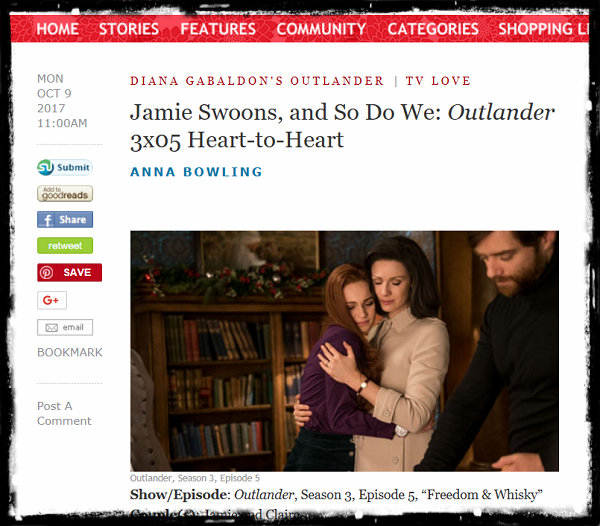
Because last week’s episode of Outlander was an odd-numbered episode, Anty got to recap it for Heroes and Heartbreakers. This was a very special episode for Anty, because it was all about Christmas, which is Anty’s favorite holiday, and it had two love stories in it. That post is here, and it looks like this:

Outlanders3e5recap.jpg

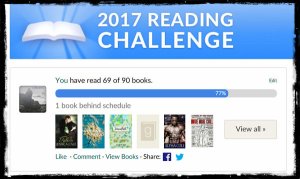
Now is the part of the post where I bring you up to date on Anty’s Goodreads reading challenge. Right now, she is one book behind, having read sixty-nine out of ninety books, but the weekend is here, so I fully expect her to get back on track by the next time she checks in on this front. If you would like to follow Anty’s challenge, it is here, and, right now, it looks like this:

GR131017

almost on track…

Anty finished reading one book this week, Southwark, by Jessica Cale. This book is relevant to Anty’s interests, because it is set in one of her favorite periods, the English Restoration, and it is very gritty. Anty loves when historical romance is very gritty. Her review is here, and it looks like this:

GRtyburncale

Anty looks forward to reading more books by Miss Jessica, and is always on the lookout for new books set in the Restoration. If you know of any good ones, please put them in the comments, and I will pass them along.

I can also pass along that, this week, Anty wrote her first scene for Drama King, and sent it in to Anty Melva. Now Anty waits to hear back from Anty Melva. Anty’s scene is really the second scene, since Anty Melva wrote the actual first scene that is in the book, but this is the first scene where the hero and heroine actually talk. I am pleased to note that the hero does consider his poor cat, waiting at home for dinner, when choosing his course of action. That alone means that this book is off to a very good start.

Drama King is not the only book Anty is writing, however, and, this week, at her critique meeting with Miss N, Anty heard those words that make her remember saying bad words in Panera is not polite. Those words are, “when do you think you’ll get back to writing (new chapters on Her Last First Kiss)?” and they come from Miss N. Anty did not actually say the bad words, but she knows that, when Miss N asks that question, it is because Anty has probably done about all the planning (or re-planning) she needs to do for this section of the book.

Overhauling half of an entire book is not something a writer goes into lightly, but, sometimes, it has to be done. This sometimes includes things like writing out calendars by hand for all the time in which the story could take place, and using those calendars to figure out how long things would take, from travel times, to how long it takes to make a new  human, and when the existing humans would be aware that the new human was underway. Because Her Last First Kiss is historical, that means Anty also has to figure out things like what foods are available when, how much moonlight there would be on a particular night, how long a party can last, and what things a human might accidentally leave behind when they have to leave a place in a big hurry.

Thankfully, Anty has most of that in place, so now it is a matter of making sure she really does have all of her metaphorical ducks in a row, and then getting back to business. Once she has everything straight, she can tell the story, without having to stop and check. That is one of the occupational hazards of being a puzzler, like Anty. Some writers are plotters, who decide how the whole story is going to go, and then follow that plan. Others are pantsers, who create as they go, with no plan. Anty is somewhere in the middle. She love to plan, but sometimes, her story people have other ideas, and she will see scenes that are not always in order. That is okay, because Anty loves to organize, so this means she gets to write everything down on index cards and make sure she has no holes in the storyline. Then she can go right through to the end. She likes that part of the process, too.

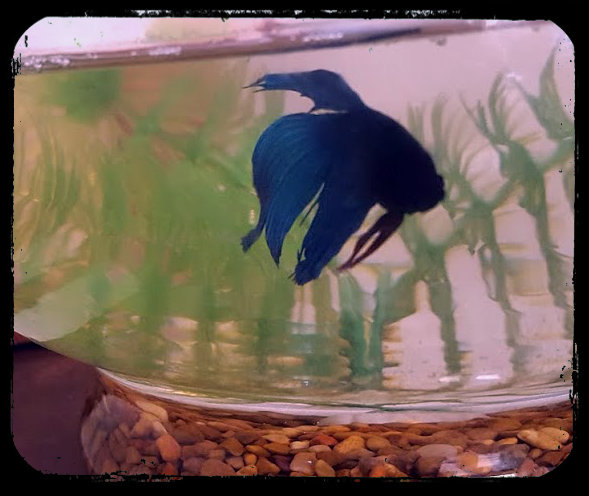
This is where Tuna Roll’s Thought of the Day would have gone, but, because Tuna Roll was all done being a fish, we will make it Tuna Roll’s Parting Thought:

0825TunaRoll

RIP, Tuna Roll; you will be missed


That is about it for this week, so, until next time, I remain very truly yours,

skyebyenew

see you next week


History, Romance, and Historical Romance

Right now, I’m sitting in my office chair, The Goo Goo Dolls playing in the background, and water bottle at the ready. Skye is curled against the office door, propped open (the door, not Skye) with a blush pink mini milk crate filled with art supplies. I have an ice pack for the finger I burned on the skillet while making sausage for breakfast this morning. My brain is still rather think-y, mostly about writing, the romance genre, and writing in the romance genre.

I’ve known I wanted to write love stories since I was far too young to be reading them, and yes, they do have to end happily. Back when I first jumped on board the historical romance train, things looked different within the genre. Books were books, not series, for the most part, and pretty much the entire sweep of history was fair game, the now-dominant Regency setting mostly in its own sphere, that of the traditional Regency. When I first started reading historicals, I loved the idea of a genre devoted to the specific spirit of a particular time, and distinctly remember asking a bookseller where the Elizabethans were. You know, like the Regencies, but the Elizabethan period, when Queen Elizabeth I ruled England. Or Tudor period as a whole; her dad’s era, or her granddad’s, it’s all good.

I remember the bookseller’s answer as well, after a few rounds of variations of “what on earth are you talking about, strange college student who is super into this historical romance thing?” There weren’t any. Historical romances could be set in any period, and, back then, they were, but these slim books with their distinctive covers only covered one historical period, and a relatively short one at that.

Well, then. Where’s the fun in that? Personally, I think there could be a market for that. Historical romances where the history and the romance are intrinsically intertwined are among my very favorites, and knowing where a reader could find stories in their favorite periods makes a lot of sense, but maybe that’s just me. I spent long hours in that bookshop, pulling spine after spine out of the shelves, for a glance at the cover, then a quick scan of the back blurb, looking for my preferred periods. In the rare case when cover and/or blurb didn’t tell me, the first page of the story usually did.

My favorites back then were anything in the 16th-18th century range, then medieval, then Edwardian, then ancient world, then whatever’s left can all mill about together. Special exception made for historical romances set in Australia. There have  never been enough historical romances set in Australia. Coughty-cough years later, my historical hierarchy has not changed, though the first three shuffle around in order from time to time. I think they have some kind of time share thing going, and I remain firm in my position on Australian historical romances. Tell me a historical romance is set in Australia, and then take my money. I need hear nothing more.

It’s a select group of romance novel elements that fit that designation. If either lead spends time in Newgate or Bedlam, give me that book. Star-crossed lovers who somehow make it work? I want that. No, scratch that. I need it. I want the struggle. I want to see our lovers get thisclose to being happy, have it all wrenched away, and then fight like hell to get it back, and, this time, they win. I’m perfectly fine if that takes multiple years, crosses oceans, or takes place on more than one continent. As long as I have a lump in my throat, my heart hurts a little, and I get to fist pump at the end, because the lovers made it, no matter what stood in their ways. Take that, antagonists, you are no match for true love.

There’s a lot to be said for quieter stories, and I have liked some of them, even loved a few. My first historical romance, My Outcast Heartis a quiet story. My hero is a hermit, and my heroine, a subsistence farmer. Dalby and Tabetha are always going to be special to me, not only because they were my first sale, but because their story could not have come together any other way. I left them happy, healthy, and a wee bit better off than they started the story. Dalby started the story living in a shack in the woods by himself, so the bar was probably low for him to begin with, but still, they ended up together and happy about it, and I don’t think they’d consider their lives small at all. Quiet, yes, but not small. All right, Tabetha’s last name was Small before she married Dalby, but there’s a difference between Small and small.

From there, I took a detour to sixteenth-century Cornwall, and the turn of the twentieth century in England and Italy, before Jonnet and Simon found themselves in the middle of the English Civil War.  Every one of those periods, and the periods I’m writing in right now -the late eighteenth century for Her Last First Kiss on my own, and the modern age for my co-written novels with Melva Michaelian, influence the love stories, so that the stories as they happen couldn’t have happened the same way in any other era.

For me, that’s a lot of the fun. How are these particular lovers going to get what they want, within the world in which they live? How have the lives they’ve led up to the point where they decide this other person is it for them, affected how likely it is they are going to get to be with this person, and what are they going to have to do, or give up, to be with this person? For me, the HEA is all the more satisfying if they have to work hard for it, and take a few knocks along the way. That’s the type of story I hope to bring to my readers, with Her Last First Kiss, A Heart Most Errant, and everything else.

What kinds of historical romances are your very, very favorites?


Of Kings and Teacups

Once upon a time, a young girl stole a book from her mother’s nightstand. She read that book under the big brass bed in the guest bedroom, and knew, within pages, that she had found what she wanted to read and write for the rest of her life. That girl was me, and that book was The Kadin, by Bertrice Small. My mom found me (darned flashlight beam) and took the book back, because I was too young to read that sort of thing. Mind you, I wasn’t even anywhere near the love scenes. What grabbed me, besides the author’s voice, was the cadence of the language, the lavish description, the sense of adventure, and being inside the skin of a heroine the back cover blurb already told me was going to come out on top, no matter what happened to her.

I stole the book back, of course, and the next one, and, by the time the third book by Ms. Small came out, I had my own copy. While I do appreciate my mother’s concern for my young sensibilities (but really, she had no problem with the horror comics I also devoured, but I don’t think she actually knew what was inside them, either) there was one other unarguable truth. This kind of story, this epic love of long ago, this was mine. Maybe I didn’t fully understand what was going on, but I did understand the force of recognition that slammed into me, in those first few pages.

That feeling has become, thankfully, familiar over the years, and yet the thrill of one of those waves as it crashes over me never gets old. This weekend’s episode of Outlander, “Freedom and Whisky,” and the episode that preceded it, “Of Lost Things,” brought a huge wave of the stuff. This also reminds me that Poldark is back in business. Yes, I know, historical fiction, not historical romance, but Ross and Demelza fit the hero and heroine roles admirably, even if Ross dropped several thousand points in our esteem at the end of last season. He may want to start practicing his grovel, because getting on Demelza’s wrong side is never a good idea.

Right about now, I would love to reference an essay/blog post about teacup romances and king-slapping heroines. I want to say it was written by Ilona Andrews, but, as I’m not turning up anything on my search results, perhaps I have remembered wrong. Even so, it’s the essence that matters, not the specifics at this point. The author wrote about what she termed teacup romances, in which characters could move through the story, holding a teacup, and not spill a drop, and contrasted those with another, when a heroine rebuffed the advances of the reigning monarch with a slap. This fascinated another character, who revealed that they’d always wanted to slap a king. Big move there, and definitely not without risk.

Both types definitely have their place, but, for me, it’s going to be king-slapping, every time. I think Janet Leslie (aka Cyra Hafise) from The Kadin would find much in common with Claire and Demelza, and, maybe, if Bertrice Small were to send that manuscript to a publisher today, it might be marketed as historical fiction rather than romance. Still, take out the love story, and the book would crumble. Could any of these stories take place in any other time and place than the ones they do? Hard no, to all three, and I love that. I love the full period immersion. In Outlander, we get three periods: the eighteenth century, 1940s and 1960s, all rendered in loving detail. The past really is a whole other world, and that’s where the stories I write, by myself, take place. Even my co-written contemporary stories have a historical tinge. I’m hardwired for this kind of stuff.

That’s the bedrock. That’s what’s not going to change. That’s the sweep and the surge and the power of historical romance that I love best, and it’s what I want to put into my own work. Taking in what one wants to put out is always a good idea, not only to see what others have already done, but what I would do differently. Watching one of these shows, or reading a book with a similar tone gets my idea hamster running. I take in some of that stuff, I want to make some of that stuff. If a few teacups get broken along the way, well that’s a risk I am willing to take.


Inside-out Week

Today is my marathon day. On a Wednesday. That basically never happens, but here it is, smushed together with #1linewed on Twitter, for which I have precisely one instance of the word of the week, “loyal,” from which to pull a quote. I made up for the lack of multiple quotes by whingeing. If this were not my marathon day, I would be sorely tempted to dig through files on my old laptop and ancient USB drives to see if I could find any of the notes for the Redcoat romance I noodled with some years ago, because “loyal” (and “loyalist”) would be all over that thing. Today is my marathon day, however, and that means I am going to mainline caffeine and cram a whole week’s worth of work into one day. One of these weeks, I will not have the need for marathon days, but this is not that week.  I am okay with that.

First thing on these marathon days is to get everything that is not related to creating a second draft of these pages out of the way. There. Done. Off my back, unable to whisper in my ear about how I really should answer that email or do that household chore, because they are already done. Once this blog entry is posted and publicized, I get to diver headfirst back into century eighteen, and play with my imaginary friends. Planner and cookie are sure signs that this is going to be Serious Business, and, while the chances that I am going to find my bed in the wee small hours are high, I’m also excited. This is only partially due to the fact that mainlining of caffeine has already begun.

Most of it is because Ruby and her Hero really do feel like friends (though I would like to think I am nicer to my real life friends than the fictional ones) and I actually do like spending time with them. Time away from them makes me edgy. The whole tracking system I’m trying out right now is, at present, a huge belly flop, but I’m going to stay the course and see how it goes for a full three weeks. That’s what experimenting is for, after all. For today, it’s get this entry up, do some longhand freewriting, reread the first draft of this next chapter, and then jump in and make it better.  As my mom used to say, the more I do, the more I’ll want to do.

This holds true even when life doesn’t want to keep to a schedule. This week, we had a weekend, with lots to do, Housemate out of town, a Monday that wasn’t really a Monday, but not really a holiday, either, and an actual holiday. Toss in there a holiday for another country, which is a special day for certain friends, and has a connection to Her Last First Kiss, and it’s no wonder I spent a good deal of that time getting the day of the week wrong. For a marathon day to happen on a Wednesday, when there’s already a blog entry and #1linewednesday, and plans for the evening, makes part of me want to ask Skye to shove over from her hunker spot under the bed (Skye did not like last night’s fireworks, especially since our neighbors were astonishingly well stocked for the holiday. To their credit, they did have a lovely display, but could have stopped a few hours before they actually did call it a night…which was actually early morning.)

Pressure to crank out a bunch of pages in one day is kind of scary, but the scariest part is the anticipation. Once I get in there, I’ll fall into my characters’ heads, and the minutes and hours of 2017 fall away, replaced by the world of 1784, which is “now” for Ruby and her Hero. They don’t know they’re in a historical. They think they’re in a contemporary.  The sights, sounds, smells, tastes, etc, of 1784 are different from what we have in the modern day, but it’s their modern day. This is their world, and their reality. This is their day-to-day, and they couldn’t care less about what some random person hundreds of years in the future is doing in that tiny green room all day.

Well, Hero would, because I have new art pens, and he would want them. His affinity for my pens is what got us into this mess in the first place, so I may take said pens out for a spin on one of my breaks. The breaks, I have found, are essential. Get some of the work done, get up, move around, get some water, do something to refill the well, and then back to it.

The farther I get into this second draft, the better I know Ruby and her Hero, and the better I know their story. I want to get it right, for them. It’s not always pretty. It’s the stripping away of images they try to present, the defenses they’ve erected around themselves, and letting the other in, to see the real them. That’s scary, because showing their true selves has garnered only rejection in the past, or put them in situations where there are no good choices. Even so, there’s that pull that tells them things might be different this time, that there is someone who actually does understand, that they aren’t the only person who’s ever felt the way they feel. It’s not the story I set out to tell when I went looking for a new story to tell, but it’s the one that found me, and, when I have a marathon day, I’m not running it alone. The characters and the story run with me, all of us, even when a Wednesday is actually Monday. I’m calling that good company.

Accidental (Story) Babies

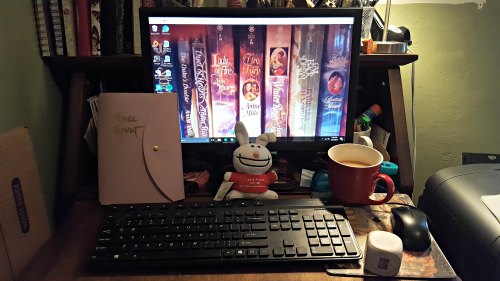
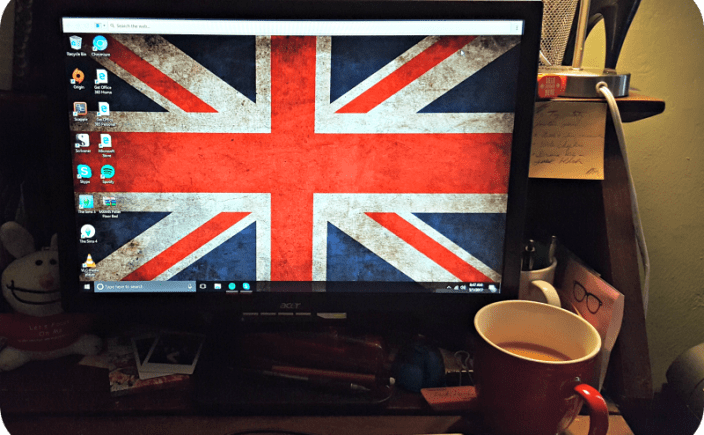
This wasn’t the deskscape I intended to post today. The deskscape I intended to post was the usual sort. Desktop wallpaper, cup of tea, couple items in front of the screen. Pink notebook, because I’m going to be making use of that for this session, and Happy Bunny, because, well, Happy Bunny.  It looked, without editing, (except for size) like this:

Deskscape053117a

Meh…

I didn’t want to change out the Union Jack desktop, same as I didn’t want to change out Ichabod and Abbie (refresher below, for new readers)

WritersDeskAug012016

Hey, guys.

but A) it bugs me when all my deskscapes look too much the same, and B) look at that nifty shelfie background, that reminds me of some of my favorite authors, and the sort of books I want to get on to other peoples’ shelves. It was an okay picture, and I fiddled with it some, in editing, but it wasn’t the right picture, because it didn’t tell the whole story.  It didn’t talk about Monday night all-nighters, when it’s me and my imaginary friends, because the rest of the world is asleep, and we slip back into 1784 together.

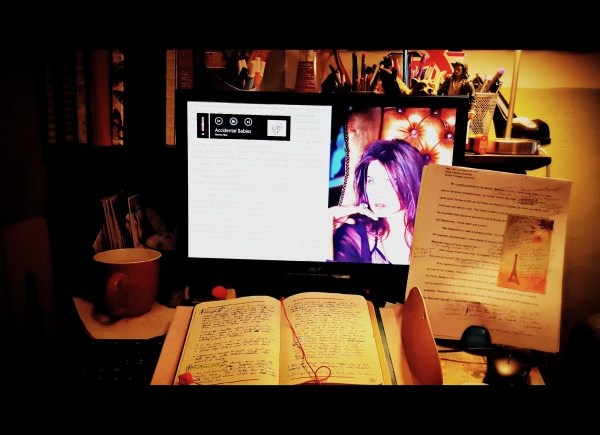
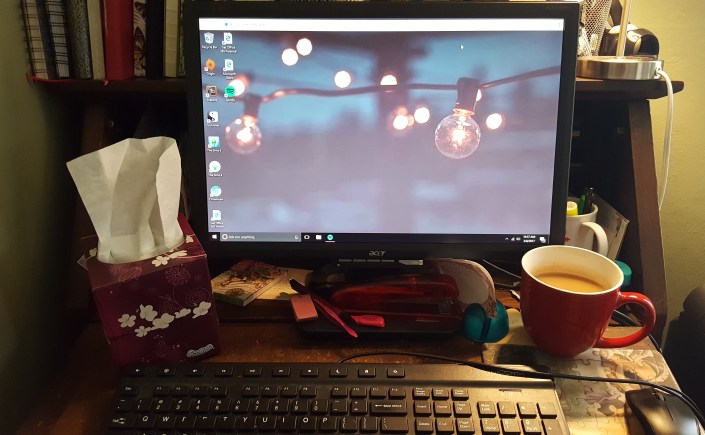
This header picture comes from me pushing back my chair to either refill my water bottle (not pictured) or feed Skye (probably both) and thinking that the desk I’d been working at for hours looked pretty cool. I took the picture. I didn’t intend to share it.  I couldn’t. I shouldn’t. It was too messy. People would see. There’s a character reference picture on the screen. People will think I “cast” my stories, and I don’t.  They’ll be able to read the text on the screen. They’ll be able to read the text on the pages, both printed and handwritten. They’ll hate it. (My dad’s voice, in the back of my head, whispers, “they’ll steal your ideas.” Thanks, Dad, but that’s not how it works.) They’ll hate me. I’m doing it wrong. Dooooooooooooom.

Uh, no. No to all of that. This is the picture that had to go with today’s blog, because this is the real picture. This is what my working desk looks like. Her Last First Kiss is not the book I intended to write, but it’s the right one. It’s not nice. It’s not comfortable.  It’s late nights and marked-up pages, and more surprises than I had expected as I embark on chapter ten of the second draft, which is what I’m doing today. It scares me.

But, Anna, another, more rational, voice in my head reminds me, you already wrote the book. Thanks, Past Me, but this is different. Now that I have written the first draft, I know Hero and Heroine better, and I know not only what they’ve already been through, but where they still need to go, and it’s…sticky. It’s messy. It has scribbled notes in two different pencils and green Marvy Le Pen ink, sticky notes both Post-It and PaPaYa! Art, and, somehow, “Accidental Babies,” by Damien Rice, became one of this story’s theme songs. I did not plan it that way, but, the first time I heard it, boom, there it was.

The lyrics are very much grownups-only, and may not be a gentle reader’s cup of tea, but, as soon as the opening notes found their way through my earbuds, I-don’t-remember-how-long-ago, the connection was instantaneous. Yes. That. It’s raw. It’s honest. It’s imperfect. It hurts. It’s right. It’s right for the story, and right for the characters, and, as I get myself ready to take that irreversible step into the next part of the book, it’s a big moment for all of us.

The scene I’m tackling now is one I’d always wanted to write, before Hero or Heroine ever showed up in my head, before the idea for Her Last First Kiss ever existed. It was one of those “hm, wouldn’t it be fun to do X, but flip the genders?” Yeah, you’re cute, Past Me. Past Me did not know Hero and Heroine when she came up with that scene idea, and she certainly didn’t know that the nameless jeweler in the last couple of chapters was going to get elbowed out of the way by an actual character, who knows other characters. She didn’t take into account that said characters will be talking to other characters, which means that Hero and Heroine are not exactly as alone as she thought they were going to be. Keeping all of that in mind goes a long, long way towards banishing the characters blinking at me from a blank white background.

Kicking Character X out of the previous scene did, in fact, turn out to be exactly what the scene needed to come alive, and now has me awash in a sea of eighteenth century underwear,  lots of virtual old-timey window shopping, fully aware now, that the walls do have ears. I get a shiver when I remember that, and it reminds me that this kind of thing can’t be manufactured. It will, however, show up if I do, and so, I’m here. Well, there. Back to 1784 I go.


Missed (Fictional) Connections

I am a planner. I need to know where I am going, and how to get there, or I will spend an inordinate amount of time circling the metaphorical roundabout, looking for the on-ramp, until I run out of gas and abandon the car entirely and head off on foot. From there, I will probably wander the moors, my lantern held aloft in the whipping wind. In the distance, a wolf howls. In short, this never leads to anything good.

Especially not in the whole area of a sustainable writing career. Which means time to plan. Conventional wisdom, right now, at least as it applies to historical romance, is that the best chances of success (as in financial/sales/building reader loyalty) are with connected books; at least three books in the same story world, preferably five. The most marketable setting right now seems to be Regency England (not my cup of tea) followed by Victorian England (same; I suspect I was born without the nineteenth century gene) and :drumroll please: Georgian England. Georgian England, I can do.  Since I’ve already set my focus, for the time being, on eighteenth century romance, this gives me a place to start, and a foundation on which I can build.

My natural bent, and still my preference, after all these years, is still my first love, the standalone romance. One pair of lovers, one story, one HEA, wave them off into the sunset and then on to something else entirely. Basically, “Well, medieval France was nice :dust palms: I’m thinking…:drums fingers: Gilded Age New York next, and maybe pirates after that. Who’s with me?” That last bit might be best read in David Tennant’s Tenth Doctor voice. Go back and read it in that voice if you’d like. I’ll wait.

I also have a strong preference for selling books over not selling books, so this means it is an opportunity to learn new skills. Last night, I sat in my uncharacteristically quiet office, the window open, no music playing, only the sound of the rain on the street outside, and looked over some options. While I browsed blog archives by other, more successful, historical romance writers, I also poked around my private Pinterest boards regarding projects currently on the back burner. I opened the board I’d kept for my Regency crash-and-burn, and de-Regencied the whole thing in one go. Wiped out every single pin that pegged this story as taking place in that particular era, no exceptions, and, immediately, I felt…relief. Now, what about reimagining this story as a Georgian? Possibilities there. I think it could work. I’d have to move some things around, but the hero and heroine wouldn’t have too drastic changes, and their love story stays the same.

Which got me to thinking about other orphaned manuscripts, set aside at various stages. Would it be possible to take the most viable of those orphans and stick them in the same story world? Now that I’ve accidentally found out how to include pictures in Scapple, I can throw my various people on the same page, along with a bunch of things that inspire me in a more general sense, and start making connections.

This is new for me. Melva Michaelean and I have planned out two more books in the same world as Chasing Prints Charming, but this is the first time I’ll have taken on something like this on my own. It’s an adjustment, and a challenge. Can I make things work together? How are the characters going to fit together, when they’ve been in their own corners up until now? The only answer I have at present is that I will soon find out, and that I will likely surprise myself on more than one level. Thinking in terms of “and,” not “or” is a big help here. I can still write my standalone stories, and I am fully aware that those may be a tougher sell, or present a smaller return than linked books. I am fine with that. It’s a good balance.

The next step here is creating that world. Part of me thinks this could be fun and the other part already has a headache.  To bring this back full circle, I am a planner. I want to know what I’m doing while I figure out what I’m doing, and, at the same time, I want some of the connections to make themselves. That’s probably part of the whole flinging everybody on the same electronic whiteboard process. I already know I’m going to have more than one artistically inclined character, and probably more than one of the gents will wear or have worn regimentals at one time, but those are places where connections can start to form. Where they go from there, remains to be seen.

Last night, while poking around my desk, I found the bunch of index cards, pictured above, with chapter headings written on the top line of each card. I have no idea what project these were meant for, but rather fortuitous that they surfaced when they did. Maybe it’s a sign. What do you think?

AnnaSelfieComment

← Back

Thank you for your response. ✨

Want vs Need

I had wanted, no, needed, this past weekend to be one of relaxing and well-filling. That was not what happened. Right now, my mind is scrambled, I have one eye on the clock, because, maybe, if I can get all my morning stuff done by noon (it is almost eleven-thirty now) then maybe I have a shot of getting this day back on track, even though what I want to do most at the moment is unplug from everything, go eat an entire pizza and dig into my towering historical romance TBR pile. Also maybe go to the park and look for baby waterfowl, because we are getting to that time of year. Baby waterfowl make pretty much anything more manageable. Do not ask me how; they probably don’t know, either.

Today, I am in the chair out of sheer stubbornness, and the fact that routine is a big help when things get domestic tornado-y. Butt in chair, check daily task list, put in earphones, select “Go To Work” playlist, and forward we go. Real Life Romance Hero is now chasing down Option C for our lunch date, as Options A and B fell through. There will be food and there will be RLRH, but that, at this point, is all I know.

After that, and after any more work needed on this blog post, if I’m not done by then, it is Her Last First Kiss time, which means rereading the chapter I brought to last critique session, which turned out to be me stuffing a ten pound cat into a two pound bag (that never ends well for anybody) and really needs to be two different scenes, one taking place before the last couple of scenes…arrgh. I’d planned to use the weekend to immerse myself in historical romance, but this weekend turned out to be one of those areas where theory and practice turned out to be two different things. I don’t like when things like that happen, but I dislike not-writing even more, and I dislike postponing critique session, so  my only option is to get the danged pages written. Which means I have to get in the mood. I’m not sure I’m going to get the chance to tuck in with a seasonally appropriate beverage and a few chapters of historical romance, because it’s Monday now, and Monday is back to work.

Last night, I gave Melva the thumbs up on our partial manuscript for Chasing Prints Charming, so today or tomorrow, she will send that on out. That will mean we have our first co-written story under consideration with two distinct entities. That’s a little scary.  It’s been a while. If I were listening to another writer tell me this same thing, I would make a game show buzzer sort of noise and tell them the fact that it’s been a while means it’s high time, and yay, them. That’s not the way I always talk to myself, though that may be a useful skill to acquire.

Only two hundred-ish words to get through this entry, and then I can talk to RLRH about lunch. After that, ready or not, it’s back to 1784, and splashing about in the shallows of a scene that is not in the first draft, but clearly needs to be (this is what second drafts are for, after all.) It’s not going to be perfect. This bothers me, but imperfect pages are a necessary evil. Comparing draft pages to pages in a published book, that has been through multiple editors, packaged, promoted, etc, is an exercise in futility. They can’t be the same, and they shouldn’t be. Where’s the fun in that?

Today, I am tackling this scene because I need to tackle this scene. Heroine needs me. She’s going to be ticked if I don’t spend the time with her today, and she’s not going to move forward if we don’t have this scene, which would mean a lot of her getting all grumbly and glaring at me and nobody is going to have any fun with any of that. I could put things off, but I think that would only make both of us grumblier. Time to put on our big girl panties and wade on into this sucker.

Lately, I’ve been making a concentrated effort to connect with what it is I love most about historical romance, and the historical romance authors who helped me fall in love with the genre. Those are the books and the authors who got my pulse pumping, and had me, on more occasions than I could count, sitting on the floor of a bookstore, either new or used, with a pile of books that I absolutely had to have, but could only take home a limited number. That meant I had to make some decisions. More often than not, those decisions weren’t based on which book was next in whatever series (as most of them were standalones, still my favorite format, and that is a whole other subject) but a gut reaction. Which ones did I need?

Sure, I wanted all of them, but which ones did I need? Which ones would hurt if I put them back on the shelves? Which stories could I not live without until the next time I could come back and comb through the treasure trove on the shelves? In a used bookstore, which books did I not want to take a chance on not being there the next time? Those were (and are) the ones that came home.

On days like this, that’s where I want to get back to; that need. What does Heroine’s scene need to be? What is she going to come out of the book and punch me if I leave out? For those who have not seen the gorgeous image by Sandra Schwab, this is Heroine:

rubyrenderschwabplain

image by Sandra Schwab

She’d do it, too. I love Heroine (Ruby; her name is Ruby, but I still want to call her Heroine when I write about her here) more than I thought I could ever love another heroine again, so I owe it to her to make sure she gets everything she needs. Which means, today, this scene. If I blow off this scene because I’m tired or cranky, I’m going to regret it, and it’s going to follow me into the supposed relaxing I’d be doing instead, which would only make me crankier and less restful. Time to bust open Scapple, throw down the essentials, and start making connections.

Rumblings of a Temporal Vagabond, part one

Okay. Deep breath. This is one of those days where I stare down the packed to-do list and charge. This past weekend, I came across a post by Isobel Carr, on Risky Regencies, called “Some Possibly Unpopular Thoughts.” My ears immediately pricked. Might this post be referencing the other post, on Smart Bitches, Trashy books? Oh, yes, it did. Oh, good. After a week stuck in the house with my beloved family, a stomach bug, and back pain, I needed something to latch all my frayed nerves onto, and this has been a bee in my bonnet for some time, so here we go.

I don’t get why, with historical romance, if we’re defining it as “anything before living memory,” which, for the sake of argument, let’s say predates WWII, it can seem a Herculean effort to sell a book set outside of one particular era, in one particular locale: Regency England. Strictly technically speaking, we’re talking 1811-1820, when King George III was unfit to rule, and his son, who would eventually be known as King George IV, ruled in his stead, as Prince Regent. Regency = during the rule of a regent. Easy enough. More broadly, the term, “Regency Era,” can apply to 1795-1837, ending with the ascencion of Queen Victoria, for more of a zeitgeist approach. For the smaller definition, we are talking a span of nine years. For the larger, forty-two years. Bit more breathing room there, even room for a generation or two to pass. All well and good there, but for those of us who write (and read) stories set outside of this era, it can be rough going at times, and yeah, my dander is up on this one right now.

There’s art and there’s commerce. There’s the book of the heart and there’s the book that sells. Right now, Regency is what’s selling. Especially Regency with Dukes. I get the desire for some fantasy in historical romance (not the elves and faeries sort) but there are also the times when my blood carbonates with the need to poke at whether it is that specific historical period and that specific rank of the peerage that seems to have a stranglehold on the market at the moment (and for more than a few preceding moments.) All the why, why, whys mosh around my brainpan, because that’s what I don’t get.

Before my life took a hard turn into caregiving, and a huge shift in the family structure, I had four historical romances published. My Outcast Heart was set in 1720 New York, with a subsistence farmer heroine and a hermit hero. Never Too Late was set in 1900 England and Italy, the heroine fifty years old when she set out to reclaim the love of a lifetime. Queen of the Ocean, set in sixteenth century Cornwall, and had a Spanish hero. Orphans in the Storm was my English Civil War novel, set on the Isle of Man, and the English Court in Exile, in the Netherlands. (Hey, I had royalty in that one. Impoverished, exiled royalty, but royalty. It’s okay. The monarchy got better.) Those were all settings I loved, that came organically with the stories that I wanted to tell, the ones that were real and alive in my head. I still love them all to this day, and those years when writing was all but (and sometimes outright) impossible didn’t change my love for a variety of historical settings . Call me a temporal vagabond.

When the writing came back, and maybe even before, that had not changed. I had to set aside a time travel I dearly loved, and needed to start something new, something smaller in scope, something I knew I could get from point A to point B. Aha. Road story. I could do one of those. Then I read the then-newest issue of the dearly departed RT Book Reviews, which had two articles, one on medieval romances, and one on post-apocalyptic romances, and my writerbrain perked. Aha! Post-apocalyptic medieval! Yes! I can do that! What would seem like an apocalypse for the medieval world? Black Plague? That, I could do, so that’s what I did.

I wrote the story of a disillusioned knight errant and a woman who refused to believe the end of the world was, well, the end of the world, who offered him the one thing he couldn’t refuse (apple seeds; it works in context.) They meet early on, they’re together the whole darned time, and I literally cried when I had to say goodbye to them at the end. Then I tried to sell it. The last agent I pitched to said she loved my voice, quoted some of my own passages back to me, and said she would totally read this story for pleasure, but was not going to ask for the full, because she could not sell a medieval. Cue sad trombone slide.

This agent advised me that my options were to trunk the story for now and hold onto it until the market changes, and medieval come back into fashion, or self/indie publish. She asked what else I had, and I mentioned I was writing a Regency. Great. Send her that when it was finished. Seriously. No question about plot or characters; just send it. I wish I could say that buoyed my spirits, I ran home, finished it, sent it in, and here’s the cover reveal, but that’s not what happened.

What happened was that characters and a story I loved turned into torture, frustration, sobbing to Critique Partner Vicki, who finally smacked me upside the head with a bat’leth of four words: “you hate writing Regency.” But it had to be Regency! That’s what sells! She didn’t budge. I didn’t have Regency in me. Set the story aside, along with the time travel, until the bad juju burns off, set it in another era, and try again.

Her Last First Kiss came complete with its setting, and, when Melva and I needed a historical period for the book within a book for the Beach Ball, I suggested Georgian, because hey, I was there already, and I knew I’d be doing a lot of the historical heavy lifting on this one. Both times, the setting was organic, not even a question. I/we didn’t pick; they picked us.

Done with blog time for today, not done with the topic, so calling this part one. See you Wednesday; let’s chat in the comments. :jaunty wave:

What’s in a Name?

Today’s topic comes courtesy of reader Kady Underwood (and, as Kathleen Underwood, cover artist for Orphans in the Storm.) Talented gal, and great question, first posed in my Lion and Thistle Facebook group, where we talk about all things historical romance. We had some interesting discussion on that one, so I thought I’d share the love and expand on my answers here.

The question:

Those of you who write…do you collect names for your characters? Have you ever liked a name and built a character around it? What comes first…the character or the name?

My (expanded) answer:

Great question. I’ll break that down into the individual questions.

1) Those of you who write…do you collect names for your characters?

Big yes on collecting names. I have been collecting name books since I was very young. I want to say eight, maybe. I remember having to beg my mother for my first one, because it physically hurt, I wanted it that much. Thankfully, she got it for me, and thus the beast was born. The collection has grown a bit since then, not counting websites like Nameberry, or Behind the Name, and shows no signs of stopping. For naming characters in historicals, my go-to reference is Names Through the Ages, by Teresa Norman, whose A World of Baby Names is also useful. I am on my second copy, which is showing as much wear as its predecessor. For modern-day characters, have a look at Beyond Jennifer and Jason, Madison and Montana: What to Name Your Baby Now, by Linda Rozencrantz and Pamela Redmond Satran. Besides having the most names ever (probably) on the cover of a book about names, Rozencrantz and Satran take a different approach, grouping the names by image, rather than origin or meaning.

Names can come from anywhere, and I do keep a mental file of names I like or find interesting, besides my collection of name books (my prized book is a book of British Isles names, published in Ireland.) If I like the name, it goes in the vault, to wait for its time.

2) Have you ever liked a name and built a character around it?

Again, yes. Jonnet, the heroine of Orphans in the Storm, actually gets this twice, because she has two names – one she was given at birth, and the other that she grew up with. Her birth name, I had been holding onto since I was in college, and stumbled across it in a historical romance I found on the shelves of the used bookstore in town. I did not get that book, and still regret it, but knew I would use it for a heroine of my own, one day. One day turned into double digit years. Sometimes, it takes a while for the right character to fit the name, but I think it’s worth the wait. I still have a few names waiting for the right character. 


3)  What comes first…the character or the name?

It depends. Sometimes I put the name out there and see who answers (I don’t see it so much as “creating” a character as us finding each other. ) Sometimes, they walk into my head, name and all, and I have very little to do with it. I even had one character tell me I got her name wrong, she wasn’t going to answer to what I wanted to call her, and if I wanted to write her, I had to use her proper name. She was right. What I wanted to call her wasn’t her name at all, and now, I can’t imagine her being called anything else.

I’ve also had a character who couldn’t tell me his given name, because he didn’t know it. We both found out near the end of the first draft, when his heroine and I both tracked down the relative who could give him the missing pieces of that particular puzzle, so it all worked out in the end.

Naming a character is different every time. Sometimes, the name does come first, and sometimes, it comes last. I’ve written chunks of outline with “Hero” and “Heroine” used as placeholders. That isn’t the case with Her Last First Kiss. I knew Hero and Heroine’s names early on, but am keeping those to myself (and critique partners) when talking about the book for now. I suspect they’ll be more forthcoming once the second draft is done.

When Melva and I first conceived the Beach Ball, the only thing we had to go on for names at first was that she wanted a one syllable name for Girl. I shot out the first few that came to mind, before we hit one we both liked. Since Girl had a one syllable name, Guy needed a longer one; his name has three. Same process; shoot out three syllable names until the right one stuck.

With my focus, for the time being, on eighteenth-century romance, getting together a list of male, female and family names appropriate to the period is probably a good idea, and I would need a new notebook for the purpose…hmmm…..

Thanks for the question, Kady, and thanks for the gorgeous cover on Orphans in the Storm.

orphansinthestorm